All posts by rogerxaustin

Probably Cats: Dexter, dedicated

Early last November we said goodbye to our loving, sweet-natured, 3.5-year-old kitty, Dexter. As some of you know, Dexter’s loss was particularly tough on both Jess and I not only because he was so young, but because we spent over two months doing everything possible to help him overcome a series of recurring urinary blockages and watching the physical toll it took on him in his final weeks of life. He maintained his indomitable spirit throughout and would have kept on fighting, but one final intractable blockage forced our hand and made us concede that our time left with him was to be numbered in days instead of weeks, months, or years.

Within hours of seeing him through to the end of his pain, I think we had both decided to get memorial tattoos. Thus began a long process of debating just what was best to use to enshrine Dexter’s life on my skin forever. I would debate paw prints on my shoulders (he loved to jump onto my shoulders at any opportunity), pictures of his face, or any of a dozen cat memorial tattoo designs I had seen in browsing for inspiration. I never felt 100% on board with any of those options; paw prints were meaningful, but I couldn’t find a design that felt individual to Dexter; I feared a face tattoo not turning out perfect and thus making me regret the decision; I saw many other sweet ideas out there, but wanted something tailored to a meaningful moment with Dexter specifically. What I ultimately called upon came from what would turn out to be one of our last good moments with Dexter, a final weekend to cuddle, play, pet, pamper, and connect with him before we said goodbye.

He had been sent home from the vet’s office, his bladder drained as much as possible via needle, and stocked with several days of painkillers. We all knew that we’d be back within a few days. That weekend was an amazing gift. He was in the best spirits we’d seen him in a while: affectionate, talkative, playful, snuggly, and voraciously eating all the tuna and grass we could offer him. Dexter also got to accomplish something he’d attempted for years without success.

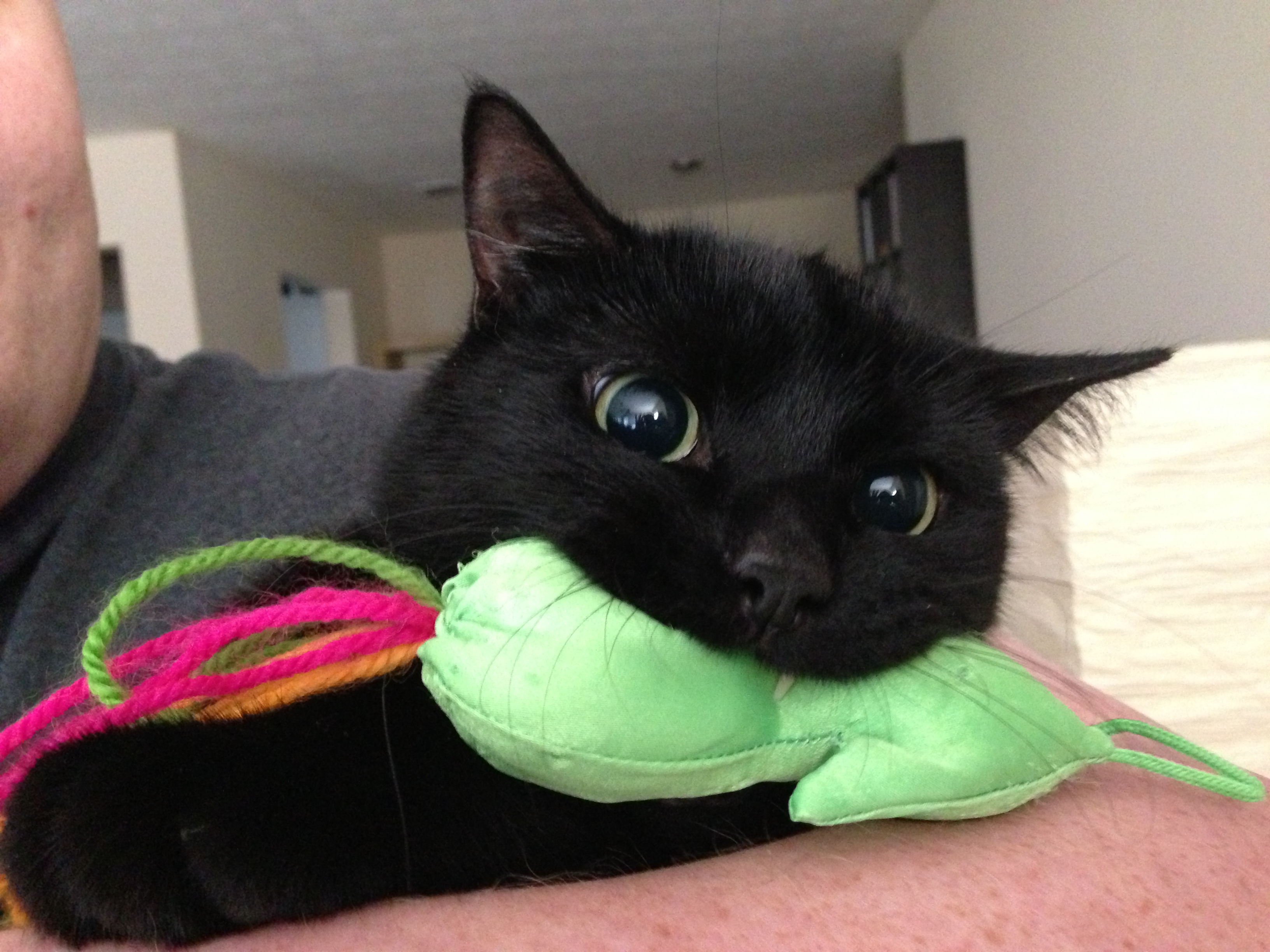
Dexter had one toy that he loved above all others: a squid on a stick.

IMG_1224

He wasn’t big on playing with toys usually, but if you pulled even the very end of the stick from the closet — even the squidless end — he would excitedly “mrrrp” his battle cry and fling himself against his nemesis again and again. His battles usually ended in a stalemate where he would seize the throat of his quarry, but somehow never manage to dislodge it from its tether. The squid inevitably would escape, wrapping itself around its home pole, and secret itself away until it would appear some weeks later. This cycle repeated for years with no clear victory to be had.

That weekend, Dexter finally conquered the Squid. When once again he had taken to furiously pulling and backing away with his wriggling prey, he set in for the long haul. He held that squid firmly between his teeth for a full ten minutes before, with one final great straining heave, something snapped. The squid was free! Dexter trotted around the apartment for minutes, proudly holding the now stickless squid up for hisIMG_1226 and parents to see. He would occasionally drop the now defeated archenemy, lick his paws contentedly as he admired his spoils, then pick it up to continue his victory lap. He revisited it several times over the next 48 hours, perhaps still proud of his accomplishment even as the building pressure in his bladder began to distract him.

We still have the defeated squid, and it sits in my desk drawer until we decide what final fate is befitting so glorious a war trophy, but it did serve well in one final task for Dexter today. I took it in with me to Timeless Tattoos where one of the artists, Dave, gladly took up the project of creating a different kind of memorial tattoo. I gave him only the squid and one vague example of what might be good from something I found online, but he did the rest. I sat in Dave’s chair and spent the next two and a half hours reflecting on all that ever made me happy about Dexter, from the way he’d bark impatiently at me when I was taking too long in coming upstairs at the end of the night to the way he’d silently implore me to turn on the kitchen faucet for just a moment even though I knew it risked making me late for work or school. During that time, I explained what happened to Dexter and why I had chosen this particular item to become his memorial. He nodded as he continued his work, mentioning how he too had lost a cat at a young age. After a few touchups and many compliments on the results, Jess and I were about to leave before he said he had something else to show us. He hiked up one of the legs of his shorts to reveal a small, blue Eeyore on his thigh. He said “I know what it’s like. I have this for my dog. It’s his favorite toy. I’m sorry for your loss.” I thanked him and left, still somewhat in shock at how well the tattoo turned out.

So here, at length, is the picture of Dexter in his moment of triumph on that final beautiful weekend and of my new tattoo honoring him.  As I said to Dave this afternoon, Dexter may not have gotten the chance to live the lifetime he should have, but now I can carry something of him forward along with me for all the years I have left.

photo

Round 2

I’ve been recuperating after the two-week marathon of reading and writing that brought the Fall 2012 semester to a close. Thinking back on it now, I can reasonably guestimate that between the student papers I had to read (finals, revisions of earlier assignments) and my own projects I had to complete, I read or wrote somewhere near 120,000 words from November 30th – December 12th. I had originally intended to write this reflective piece after finishing the first semester, but think now that it was better to wait (read: be lazy). I’ve gotten some distance, and my brain has reassembled somewhat. I’m ready to move forward.

In moving forward, I feel I must look back on what I managed to accomplish in my first semester teaching College Composition I, and what I can be applied to College Comp II, which I start teaching this week. I’m trying to keep an eye toward the student experience. As I’ve acknowledged here already, I know that I defaulted to a mode of instruction too basic and safe: four papers, too much lecture, reliance on teaching the classic research paper model as the exemplar of college writing. For the uninitiated, this of course sounds like what students should be learning, so why would I be dissatisfied? I absolutely do not regret covering what I did. A first-year writing course should be concerned with coherence, detail, support, revision, research, audience, among many other aspects of “good” writing. So my first semester teaching comp was a success in that I covered what I needed to, but was that enough? I don’t think so.

I’d like for students to be engaged by more than an expectation that they will be engaged – I want that to be a more natural, organic relationship than my last class necessarily supported. I think a lot of the difference between a merely successful learning experience and a valuable learning experience comes from this gap. I also want to tread carefully here; I’m fully aware of the cliché college instructor in jeans and corduroy blazer, pleading for his students to “write whatcha feeeeeel, man!” Assignments and activities have to mean something to the student, but I am here to accomplish the above musts of a composition course.

I’ll have the opportunity to apply these lessons to College Comp I (1101) the next time I take up sections, presumably next fall semester, but I’ve also let this dissatisfaction inform how I approach College Comp II. I’ve decided to abandon the series of increasingly difficult papers model and instead focus directly on the writing process in manner that will be more innately appealing. I hope to do that in two ways. First I’ve organized the material of the course around something contemporary that many students are already steeped in without knowing it. Using the (E)Dentity reader (edited by Stephanie Vie), a collection of somewhat recent essays on issues of digital identity and negotiating online experiences, I believe students will find the topic relevant to whatever modes/arenas they conduct themselves in digitally. This is hopefully scalable across multiple levels of digital identification, from the deeply-immersed to those who may have little or no online presence. Ideally, everyone can find a place on the spectrum where they can say “here is where I am comfortable” or another where they can say “here is where I want to be.” The challenge from this topic will be keeping the conversation from reducing down too simply about services and ignoring deeper thought about digital identity.

The second way I anticipate this model can help students is by trying to replicate a level of scholarship that should hopefully exceed the complexity of writing they’d face in the near future. Essentially, I hope to have them construct a significant piece of scholarship that they can be confident would measure up to the scrutiny of the same community we constantly ask them to draw from for their research – academic research journals and edited collections. This may seem like too much to ask of someone so new to college-level writing, but I believe it can be reduced down to a series of parts that, taken alone, wouldn’t be cause for much stress. This is where the emphasis of process comes in, by showing how simple it is to assemble a process that accomplishes a great deal of work – something will be asked of them countless times over the next 3+ years of education. It may seem hard – and it would be insanely harsh of me to ask for what I will if I did so as a final paper assigned only weeks before it was due – but my ambition is to show them the benefit of a plan.

I’m fortunate in that I’ve recently experienced a unique approach to doing just this. Toward the end of my MA studies at University of Michigan-Flint, James Schirmer conducted a summer session graduate class modeled loosely after the idea of a “Book Sprint.” In short, the ~15 grad students in that class collaboratively conceived, planned, researched, and wrote an edited collection on a single topic, with the idea of book-level publishability as an end goal. I loved the class concept and enjoyed the process. It made a large project accessible and frankly not at all intimidating. I hope to replicate that same effect for my Comp II students. From my syllabus, introducing the modified version of the course James and I have come to call Text Dash:

This section of ENGL 1102 is modeled loosely on a method of compressed, focused, collaborative writing academics sometimes use to rapidly produce a collection of scholarship on a narrowly-defined topic. In a traditional “Text Dash,” the text is crafted from idea to finished product over the course of a long weekend. In ENGL 1102 we have the opportunity to space that out a little more. Over the course of the semester, you will gradually build the familiarity, resources, and skills necessary to collaboratively produce a well-informed and informative text of scholarship.

At the end of this course, you should be more than prepared to meet the demands of the academic writing assignments you will encounter as you continue at Georgia State University. (emphasis added here)

The Text Dash model will take students from familiarizing themselves with the in-progress discussion, through deciding what they can add to that discussion, to writing a fully realized, coherent, collaborative discussion of their own. From there, the course will replicate the process of taking on so large a project, and as a result, more organically cover all the things we think “good” writing must exhibit. The course will be divided into phases of preparation, research, drafting, and revision before submitting a “final” copy. Only one single paper will be written throughout the entire semester, but the process will space students evenly through the major requirements of pretty much any sizeable writing project, and all with the goal of something in-depth and publishable.

The last sentence from the syllabus above is exactly what I want from this course and why, as daunting as this class may sound to my students now, I’m betting they will stick around. While I won’t necessarily ask the same length of writing that such edited collections normally would, and my primary aim is not to actually publish their work (putting completely aside concerns of whether I even can ask them to put their work out, or what form it can legitimately take), I do hope they arrive on the other side of the class thinking that it wasn’t all that bad taking on so large a project. Ideally, the projects they face in the coming semesters can then be greeted not with panic or stress, but instead with “I’ve done something bigger than this. Let’s get started.”

8900: Enabling recomposition

So I found out there’s a term for something I’ve considered in my own writing for a long time, but Ridolfo and DeVoss call it rhetorical velocity. Instead, part of my composition process has always been to ensure I include a handful of clear sentences that, if stripped of their context, could still manage to communicate key concepts of the text I’m composing. I’ve thought of it more as mile markers for my readers, or even as a rhetorical device. My writing could be characterized as generally too loquacious, but I try to include cogent and succinct statements often.

A device I’ve used often to encourage rhetorical velocity is what I call the “tweet test.” I use it most often in blogging by trying to leave sentences or two that I could visualize someone using as a direct quote. I keep it to 100 characters to allow this fictional tweeter (it’s only happened once or twice throughout all my blog posts) room for a shortened url, my user name, or any other brief thoughts they’d want to include. My thought in writing it this way is that I’m helping my reader know what I find most important, and hoping that if they agree, I’ve given them a concise, interesting tidbit to share with others. I can see how, in determining if a blog post passes the tweet test, I’ve considered a lot of what Ridolfo and Devoss place in the left column of their “Rhetorical Velocity as a Concern of Invention” model:

  • I’ve assessed who might be interested;
  • I’ve considered why these persons might want to share (recompose) my work;
  • I’ve considered what the recomposer might produce, how it may be delivered, and have facilitated it by conforming to tweet-friendly lengths;
  • By intentionally keeping to so short a format, I’ve also enabled cross-platform sharing (not that I presume anything I write is so compelling that it must be reshared on Facebook, Google +, and other blogs);
  • And I obviously assume my writing’s temporal lifespan will be extremely limited, since I’m using Twitter as the standard.

Quite aside from my personal composition device, rhetorical velocity has definite potential in a computer-enabled composition course. If the course plan includes some degree of new media writing, introducing and applying the rhetorical velocity model for several weeks of writing assignments lays the groundwork for understanding the decisions of the writing process at large. The benefit here is that you can discuss and apply these concepts without using the old standard collection of composition instruction power words, but they still apply. Asking our writers to make sure they know and can show the answers to the model’s seven questions passively supports terms like audience, rhetorical situation, argument, illustration, and agency. As is so often the case, students have had previous composition experiences driven solely by these words of power, so anything to divest and reallocate rhetorical power is worth trying. Linking basic composition concepts back to this model is a game of pedagogical smoke and mirrors, I’ll concede, but it could be effective.

Probably Cats: Dexter, declining

I wish the first time I actually fulfilled the “probably cats” part of this blog’s tagline was for a happier topic. It was something I’d do some day, thinking the perfect topic on which to cat-gush would strike out of the blue. I’d even thought I’d like to do an introduction post for each, such as “Meet Monty,” or “Meet Miles.”

So, Meet Dexter; I wish I’d gotten to this earlier.

Dexter came to us in the most normal of ways, through Lansing’s Capital Area Humane Society.  We adopted him as a kitten in May 2009, about a month after losing 14-year-old Thacker to renal failure. He instantly filled us with mirth and happiness, and though we were still grieving the loss of an amazing and devoted friend, Dexter began squiggling and biting his way into our lives; for almost a decade our homes had been defined by the presence of “Monty and Thacker,” and then it was awkwardly Monty alone for a brief time. Dexter restored the unexpectedly significant “and.”

Something strange happened as Dexter grew. I think our loss of Thacker – the first loss of a truly close companion animal either Jessica or I had faced as adults – took a long time to discharge, and that made us wonder if we would ever connect to Dexter the same way we had with Thacker and Monty. Monty, incidentally, was finding his own difficulties in moving from the status as the baby of the household to elder brother and living training dummy for a black poof of teeth and claws. Monty’s reservations for the newcomer were understandable, and I suppose our own were par for the course, too. Over the first few months of Dexter’s life with us, we enjoyed his company more and more, and began to feel assured that he was on his way to his own niche, but we never felt we were head-over-heels infatuated with him. He was a great kitten who was a ton of fun, but that seemed like it.

That changed when Dexter was about six months old, and in the oddest way. Jess and I briefly considered the benefits of having a house cleaner, seeing as we were feeling increasingly stretched for time and knew we weren’t keeping up as well as we should. That plan fell apart soon thereafter, but we did invite one particular candidate to our home in Okemos, so she could get the layout and specifics to get a better idea of what we would need from her. She brought her husband and toddler son with her, as they had planned to run other errands while in the area.

I’m not a kid person, as anyone who knows me can figure out. I’m not a child hater, as is often misunderstood by some; kids are unpredictable and I rarely find the things they do as endearing and funny as others. But this kid, this house cleaner’s little boy, is responsible for our seeing Dexter as he truly is. Within moments of the trio entering our house, Dexter and the boy had locked eyes and converged. It was genuinely cute, watching this child squeal with delight at Dexter’s friendly nuzzling and sniffing. It was, for Dexter, a moment that defined how we’d view him for the next three years. He was transfixed by the child, but just… friendly. He kept marching around the boy, his tail straight up in greeting, his front paws flexing in the kneading gesture cat people recognize as contentment or intense interest, and his purr loud enough for everyone to hear. For a few minutes, Dexter and the child contentendly orbited each other like a binary star system, sharing their common core of fascination, friendship, and bliss. The family left soon thereafter, leaving Jess and I completely stunned by his behavior.

That was when we stopped just liking Dexter, and fell in love with him.

Dexter is sick. We’ve learned in the past two months that it’s very common for neutered male cats to develop urinary tract blockages. The feline male’s anatomy for eliminating urine is poorly tuned, predisposed to infection, blockage, and pain due to its very narrow urethra. To help visualize, think of the female cat’s urethra as drinking straw, but the male’s as a coffee stir that still has to function after bending at a right angle.

The first event happened about one month after unpacking here in Atlanta. We awoke on the morning of August 30th to find him breathing heavy, curled up tight onto himself, and coughing strangled cries of pain. A nearby vet hospital was able to get him in immediately, thankfully, and we learned he was totally blocked and his bladder was distended. He was catheterized, drained, and flushed; we were told he was extremely lucky because we got him in before his bladder or kidneys were damaged. We also learned that Dexter was the proud owner of the world’s narrowest and thinnest urethra. He came home on the morning of September 1st to parents who were now educated and prepared to deal with a FLUTD kitty (Feline Lower Urinary Tract Disease). Special food, multiple points of access to flowing water, and close observation gave us some hope that we had avoided catastrophe and would be able to adapt to a special needs pet.

Dexter was back in the hospital by September 4, blocked once again. On the recommendation of his doctor, we decided to fast track the drastic measure we would have considered only if he blocked three times. A second blockage only three days after the first was cleared was obviously grave. Dexter underwent a surgery for a perineal urethrostomy. By removing his genitals, the urethra was significantly shortened, leaving the wider and less likely to be blocked portion behind. He spent almost a full week in the hospital and in recovery.

His at-home recovery was full of pitfalls. He had to have an out-patient catheter put in twice, both to ensure he was draining fully, and to correct a case of fatigued bladder muscles. He constantly dripped. He was routinely eliminating outside his litter box. He would sometimes urinate small (and occasionally not so small) amounts of blood. He developed an infection. He lost over three pounds – nearly a quarter of his body weight.

We had hope throughout because of a few crucial things. First, he was peeing regularly. Whatever else had happened, the urethrostomy appeared to be a success. Second, he was continuing to go about the business of living. He ate enthusiastically despite the weight loss, kept himself as neat as he could, given the messy condition he was in. Most importantly, and still the case today, is that the same happy, lovey, affectionate cat whose disposition is as sunny as his fur is dark is still with us. He wants to be the same. He still raises his tail straight up when you address him, and it still quivers with unrestrained eagerness when you reach down to pet him. He still marches in tiny circles when you prepare his food, something he’s done since he was a kitten. He still sticks his nose deep into my goatee, snuggles and rubs around against it, makes a tiny snerff sound when his nose is inevitably ticked by the hair, and finishes by ramming the top of his head into my chin. That Dexter wants to keep living the same cuddly, content, peaceful life he’s lived for the past three and a half years.

Wanting something is powerful, especially when it comes to wellness. Wanting to stay and fight keeps people and animals around instead of succumbing quickly to wasting diseases – we saw that with Thacker. Even as he dropped from 14 pounds to just six as his kidney failure progressed, he stuck around because he wanted to. He wanted to be with us, to grumble at us, to rub against us, and to end his day at our feet. That carried Thacker a full six months beyond his diagnosis before we saw the sign that he no longer wanted to stay. Wanting is powerful, but sometimes wanting just isn’t enough.

Dexter wants to stay with us, but he may not be able to. On Halloween, he began peeing large amounts involuntarily, leaving large puddles or spots where he slept. We took him in to the vet one more time. I can’t say if I knew the news was going to be bad or not, but I feel like Jess and I knew the other shoe was about to drop somewhere in our hearts. The doctor confirmed his bladder was distended once again, and proceeded to attempt a catheterization to clear it; it didn’t work. As far as she can tell, Dexter has developed scar tissue deep inside his urethra – possibly a byproduct of the earlier catheterizations, but certainly related to the trauma of the past two months. The scar tissue is preventing the doctor from actually entering his bladder to drain and rinse. Dexter’s stuck in a loop.  He gets so full that he begins to become extremely uncomfortable, he licks, rubs, and pushes to no avail. Finally the pressure of too much urine in his bladder is what dislodges the tissue blockage enough for a gush to pour forth, but never enough to empty his bladder. The bladder begins filling again, and the process repeats.

The options for Dexter are unpalatable. Another, more invasive surgery to place a catheter from inside his bladder offers no real chance that he won’t simply reblock again after it is removed; we’re not actively solving the issue, and his bladder muscles have also weakened again from being constantly stretched. Of further concern are the concomitant risks of significant surgery, infection chief among them. We could take a referral out for a specialist with different technology who may be able to place the catheter non-invasively, but that doesn’t address the same after-removal scenario.

We spent yesterday day scrabbling for something to give us a chance to treat Dexter one more time. We’ve found nothing. What we are faced with now is that, aside from some pills to help strengthen his bladder muscles, we can do very little for Dexter except keep him as comfortable as possible. We’ve decided not to pursue a second opinion because of the battery of tests and prodding that would inflict upon the poor little guy. In essence, we are out of options. We can keep our fingers crossed that somehow this suspect blockage resolves itself, but sometime very soon we may have to accept that Dexter shouldn’t keep going, no matter how much he wants it.

Jess and I wondered why this time felt different than with Thacker. We had Thacker for eight of his 14 years (adopt an older shelter cat if you haven’t yet; knowing Thacker stands as one of my most worldview-altering experiences). Thacker was an amazing friend who seemed so much like a person, and he died in a slow, at times very painful manner. Dexter’s probable fate feels like a much more savage wound in my heart, and I feel already that this one will take longer to come to terms with than did Thacker’s passing. Jess and I wondered why this was until we realized it was a difference of hope.

Even in Thacker’s most horrible moments – such as a rocky Christmas Eve in 2008 where we went to bed certain he was going to be gone when we woke Christmas morning – we had a reason to hope. We could hope for one more day, week, or month of Thacker feeling comfortable enough to stick around so long as he wanted to. That hope is missing in Dexter’s situation, and all we have to replace it is vague, directionless wishing for a miracle that’s all but impossible.

Right now, Dexter’s happy. He’s purring, he’s playful, and he’s engaged. In fact, he seems better than we’ve seen him in weeks. In his mind, the blockage isn’t a big deal. But it will be a big deal eventually, and probably sooner than later. Beyond all my ineffectual rage that it’s unfair that a cat of only three and a half years – practically a kitten! – is facing his probable end, I’m stricken with a sadness that Dexter won’t be able to make this decision for himself. If this moment comes, we’ll be putting to sleep a creature that is healthy in every other possible manner. A friend who has been so sweet, kind, and loving to virtually every other soul he’s encountered will miss out on so many more souls because of the tiniest little glitch in his body. It’s not just unfair.

It’s unfathomable.

EDIT, November 5: We said goodbye to Dexter this afternoon. As expected, he declined quickly until it was undeniable he was in pain, and possibly kidney failure. He was loved by everyone who knew him, and he loved in return. He will be missed more than I could ever hope to express in words.

8900: The false god of device convergence

I resonate with Henry Jenkins’ preoccupation with the black box effect, and I think the fourish plus years since the publication of Convergence Culture has only deepened the ongoing kludge of our relationship to media technology. Every feature integrated into a device, a new digital community, entertainment venue, or writing space beckons us to acquire more hardware. What we end up with at the current time is both convergence and divergence.

As an example of the divergent, I’ll fess up to some of my own embarrassing hardware missteps. Around 2007, I had thusfar resisted and in fact disdained the Blackberry trend, boggling at how difficult it was for some people to simply disconnect and acknowledge that their time just wasn’t that important. Then came the first iPhone. While my needs for mobile communication had not changed, I, as so many did, fetishized the device. I was lured by the promise of integration – of convergence. Here was a device that was both my phone and my music player, something I had actively been annoyed at carrying separately at this point. The fact that it also offered continuous access to interesting or fun or useful or illuminating content was not as important, but was easily rationalized in favor of its purchase.

I sat out the rush for the first model and came on board with the iPhone 3G. It was everything I wanted it to be, but it wasn’t perfect. I realized its limitations; it wasn’t a robust processor, it provided fenced-in content, and I realized that while it was great for short writing burst, its tiny touch screen came up short for lengthy writing. I never expected it to replace my laptop or desktop. I happily used it and enjoyed as its usability expanded through various updates, and moved on to the iPhone 4 two years later.

Concurrently, my interest in the iPad was increasing. I know this makes me sound like an Apple fanboy, but what I was drawn most to was the form factor. Plainly stated, it was just a big iPhone, but I hoped it would be the balance between the bulkiness of a laptop (the same laptop whose lightness, thinness, and relative power I marveled over only a couple years before) and the confines of the phone. Again I resisted for over a year, but again, I broke down and my wife and I bought one to share.

This is where the divergence begins to reappear despite all these seemingly convergent devices. Despite some buyer’s remorse over the iPad – for it really was just a big iPhone, so what did we expect? – the device has remained and inserted itself into a niche of use. My relationship with four very similar devices is thus: the phone I obviously carry with me everywhere (the irony of my former disdain for the Blackberry cult is not lost on me) and use so frequently for tasks both silly and serious, I cannot see having a “dumb” phone again. The iPad does what I don’t need the laptop’s serious power for, and also enables me to engage in longer and more comfortable screen reading than a laptop can, such as reading articles for classes and my own research. The laptop is there for when I need to seriously settle in to productive, high-intensity writing or research. Finally, a self-built PC desktop rounds out the onslaught as my access to the more processor- and graphics-intensive gaming world, something my laptop was incapable of doing for very long.

I have four devices that do extremely similar things, yet I’ve let them settle into precise and unique roles. This list can expand further, with my wife having a kindle for sustained digital reading, and our accumulation of 10 years worth of gaming consoles, an internet media streaming device, and a music and video serving device. Even one of the consoles has a fractured identity, having found new use recently in streaming downloaded video through the gaming PC. What galls me about this is that despite my wish to simplify, I have carved out so precise a niche for each of these items that I have difficulty considering how to let one go.

Thus, the divergence Jenkins foretells is realized, but in the name of convergence. I can’t deny the device fetishization at work, but each time I’ve acquired one of these devices, its cost relative to its offered service always seems a bargain. Before long, the device has carved out its niche and another golden calf appears on the horizon, promising to be the one device you need to restore balance to our fractious, fraught hardware existences. While I believe only the laptop holds the distinction of being truly required, I know I would sweat the loss of functionality the rest of the pack brings. I can only hope that true convergence happens in the near future, bringing a single (or hell, at this rate I could get by with only two or three) convergent messiah device to unify all these digital wants and needs, and that this is just the divergent storm before the convergent calm.

8900: Emergent Aurality

Situated Aurality

One of the resources included in our reading/listening this week was the Soundmap from Rhode Island. After clicking through a dozen or so places around the tiny New England state, my first reaction was “Meh. So what’s the worth?” I appreciated the concept, and thought its interface within Google Maps was accessible, but I had difficulty articulating its worth. My next thought was, as close to verbatim as I recall, “I’m sure it matters to Rhode Islanders, but it’s not unique; Georgia/Atlanta has a similar project , and so did Michigan.”

I was immediately struck by a wave of homesickness for Michigan, went to its Sounds of the State page, and found the sound closest to where I lived, a lone blue dot in East Lansing titled “MSU Medley.” My ears drank in ducks on the babbling Red Cedar River, Beaumont Tower’s distant carillon bells, and the route announcement of a CATA bus. I was immediately resituated from my desk here in Smyrna to the riverside between the Hannah Administration building and Wells Hall, my feet dangling over the water and ducks pulling at my shoelaces because I was too slow in crumbling up the stale bread I’d taken from Brody Hall’s cafeteria earlier that morning.

That soundscape has become part of my experience, and will always be one of the places I can situate myself. I was there. That has meaning to me. I spent a few more minutes clicking around the sounds back in Michigan, smiling and nodding at a few that resonated, and shrugging at some that had no significance. And so it must be for people living in Rhode Island. Whether they’re down the road or across the world from Narragansett, sounds from its shores, piers, and streets situate them in their experienced places. These sound maps are worth more than their appeal to listeners outside the covered region, more than a digital drinking glass held up to a door for auditory voyeurs; these sounds are, for the residents, communication that carries something much more than the surface level detail. This is auditory composition, and it is a composition that is acutely aware of its authorship, its audience, and its message.

Crafted Auality

Somewhat briefer, I’d also like to acknowledge Jessica Barness’ Common Sounds project. Rather than letting the audience be just the audience, Barness invites them to take control of a handful of layerable soundtracks. I’m sure my progression through this was just like anyone else’s: try each sound individually, shrug and say okay. Then it was time to layer ALL the sounds! I, like everyone else who tried it did probably did, winced as the layers grew into an inarticulate cacophony. I resisted closing the window and I found that my auditory processing was up to the task, no matter how distasteful. My mind quickly organized the sounds into a unified piece that had rhythm and melody, even if a little too eccentric for my usual listening tastes. What occurred to me next was that I was listening to an entirely unique piece; each sound was playing in the order I layered it, which of course was situated differently in time to the sounds already playing and those yet to be added. Likely no one else (or at least very few others) chose the exact order and relative timing of the layers I did. I didn’t let it play long, but I enjoyed the tasks both of listening to the whole, and mentally isolating the individual layers while the rest continued to play.

I’d like to share a similar flash app with the class called The Chrome Project (although it should work well in any browser). I’ll leave it to you to figure out, but I think you’ll find the same sort of self-crafted aurality here, and the same challenges in contextualizing and isolating the different sounds. I hope you enjoy the process of tweaking and refining your compositions.

Pedagogical Aurality

With this week, we appear to be leaving behind the section of the course that has been the most enlightening to me so far. We’ve established that I’m now acutely aware of the fact that composition is a term much broader in scope and content than just writing. Not wanting to make the same mistake I did when we first began our talk of interface and the visual in composition, I kept my mind open regarding aural composition. What I’m left with now is the idea that perhaps composition is better (if somewhat muddily) defined as manipulable communication. Whether we’re engaging in verbal/written, a verbal/spoken, visual, or auditory communication, it is still communication we’re wholly in control of, both in form and content.

A few years ago, during my MA composition pedagogy course, we were asked to craft our teaching philosophies. Most of what I wrote now seems situated perfectly to where I was in my still very rudimentary thoughts on the teaching of composition, a plucky manifesto filled with vague affirmations of responsibility, open communication, and grammar vs. content. It wasn’t all together myopic, but it also wasn’t altogether well-informed. I’ve since discarded that statement, but have referred to it multiple times since, using it as a sort of mile marker in my pedagogical maturation. Most of what it contained is useless to me now, but as time progressed, one cogent, critical statement emerged from the detritus:

My specialty is my passion: writing. The written word is a pure form of discourse, no matter the writer or the audience. Writing provides the author the opportunity to present his or her most considered representation of their thoughts, their identities, and their beliefs. Each word, each thought can be chosen amidst a myriad of alternatives. Each such choice in expression gently shapes a writer’s voice, leaving a unique fingerprint on every work they undertake throughout time.

It’s been tweaked and remediated several times, but the core of what I wrote remains the same (and, oddly enough, its current form above appears on my LinkedIn page, of all places).

So, with my recent revelations in the visual and auditory realms of composition, now it’s time to consider revising it yet again. I come back to the thought of composition as manipulable communication. So long as the author/artist has control of a medium and a message to send, they’re composing. While I may personally have a particular passion for writing, I will do well to at least mentally swap in “composition” for “writing” in my teaching philosophy.

8900: Reflection

Thus far

Up to this point in the class, a simple thing has had the biggest impact on me professionally: expanding the definition of “composition.” I can’t begin to answer why it’s so, but I realize I have had a very restrained interpretation of that word when it came to first year composition courses. Even though I knew composition happens in many modes, I kept thinking writing, teaching writing, the writing process, and how writing is supported. Somewhat blithely, and despite many experiences and discussions that should have expanded my viewpoint, I kept focused on how I would be a writing instructor.

The past weeks of visual literacy work have had the biggest impact so far. Here again, understanding what is included in “composition” is key. When thinking about visual rhetoric, I recall that I’ve always been intrigued by the use of visual presentations in composition classes, but felt their inclusion risked missing the valuable development of writing. In this retrospect, I can’t fathom how I never made a stronger connection in my own mind. As discussed in an earlier blog post, I realized that when faced with the wide-open world of options on how to teach, I simplified things by retreating to a very analog format.

And so now I turn to reconciling this refined definition with my formative pedagogy. Already I’ve decided to get more visual than I might have without this insight. In the past few weeks, more of my in-class exercises have included visual elements, and I’ve already decided that digital and social writing will feature much more prominently the next time I lead a section of English 1101. A simple change to my current run was to reform the ongoing writing project I had planned (which I was reluctantly about to make a simple journal) into an ongoing discussion to prepare for the term’s final project, an open-topic research paper. A series of low-stakes uLearn discussion board posts have done far more to get my 1101 classes thinking about their writing processes than a simple open-ended free writing journal could. It’s not without its flaws and I’ve yet to see the final results of course, but I expect this simple use of digital writing in their composition processes has done a great deal of good. Perhaps a critical strength of this approach is my non-involvement with their discussion. I’ve divested myself, at least temporarily, of the be-all for how they approach their topic. The longer I can keep their perception of my perception off their minds, the more they can learn about how they compose.

For English 1102, which I assume I’ll have for at least one section next semester, I’m already planning to further open student writing to larger feedback by moving to a unified course blog. While it may be too late within my syllabus structure to effectively do so for Fall, my Spring classes will definitely feature a wholly visual project as one of the major grades. I look forward to convincing them the hallowed criteria for effective verbal writing are still relevant to effective visual writing.

Toward the end

Looking now at the end project, I’m going a slightly different direction. Back in my Graduate Resource Network presentation for Computers and Writing 2011, I began the process of looking into a thorny issue I faced several times at my writing center at University of Michigan-Flint. Inspired largely by a tutorial gone horribly wrong earlier that year (Wherein one slipped through a crack), I asked a vague question about how universities deal with the truly rare, truly technologically unaware/incapable – the people Prenksy must’ve had in mind as the worst of the Digital Immigrants. I’ve yet to experience this type of tutorial here at GSU, but I’m convinced this type of student can be found anywhere.

At the time I wrote that post, I was thinking of it from just the tutor perspective. That may endure as I take this project forward, seeing as writing center theory and practice continues as my main research interest. Regardless, it’s a question that all of composition theory must address, and that computers and composition researchers may be able to help me answer: since we must accept that in times of economic recession, non-traditional students enter college for the first time with little or no functional computer literacy, then must we develop a strategy to mitigate this disadvantage?

This recalls the earlier weeks of 8900 where, along with Selfe, we acknowledge that failing to expose students to computers denies them computer literacy. Now it has shifted. Functional literacy, if not proficiency, has become the standard assumption. Yet we will continue to have students who do not or cannot this expectation. How do we accommodate them? Is this illiteracy statistically present enough to even bother with? How should we address it if we decide we have this obligation?

Like during my feedback session at the GRN, I’m struggling with the feeling that I don’t know if I’ve refined a research question well enough to take this on, or if I should even consider the topic under my authority.