Category Archives: Uncategorized

Transition

This marks the first post of this relocated blog. I get to feel all special for finally doing the 1999 thing and registering my own domain.

As far as already-present content goes, what comes before this post is an import of content from my Blogger blog. I kept most of what populated that blog, but did cut some of the more unrelated content from when I started writing there in 2009. Most of the earlier stuff had to do with class-required topics from one of my first University of Michigan-Flint classes, a course on digital rhetoric and new media in the classroom. The blog went silent for about a year until I resurrected it and refocused it as I began work on my MA thesis, an ill-fated and presumptuous answer to questions of the author’s fate as the ebook/ereader market exploded. I’ve maintained it sporadically since.

I intend to keep to mostly the same topics here, and because any blog relaunch or relocation wouldn’t be complete without empty promises to write more, I’ll vow to post more entries on more topics. That brings me to my thoughts on how I’ll choose what I include here.

When this blog launched for that UM-Flint class three years ago, my instructor and now friend James Schirmer introduced us to a term for a condition I had not realized was definable: multiphrenia. This term describes the sense of personality fracturing we experience as we engage with an ever-increasing number of social environments, particularly digitally. As Schirmer explained then, the multiphrenic self is constantly choosing which self to be in which venue. We experience great pressure to craft unique personas for each place, be it Facebook, as instructors online, in emails to students, in emails to faculty, on Twitter, in online games, when writing for blogs, or any other digital space we inhabit. One of the greatest assets of a digital life – the ability to seriously consider what we say before we hit “submit” – can turn against us as we experience anxiety over how we will be perceived once our text appears on someone else’s screen, so we fracture ourselves into our different aspects.  To see how we dissociate these facets, look no further than the methods Facebook and G+ offer to sort our connections into groups or circles. By enabling the sorting which information is sent to which group, we’re encouraged to be different things to different people online.

It is this identity stratification I’ve decided to resist. This blog will be refocused with this in mind. One of the causes for the large gaps between my posts in the past (not the cause – I can tend to be lazy, too) was my apprehension over what I was including. As you may see from the post before this one, I recently experienced the gut/mind/soul-wringing process of gaining admission to a PhD program (I was accepted to Georgia State’s Rhetoric and Composition, by the way). In the months between summer of 2011 and April this year, I’d had many notions to post on any of several topics, but I always froze when I asked myself one question: what if someone from the admissions committees at one of my schools decided to take a look at me beyond my application materials? Was I comfortable putting myself out there more and more, especially if it was more off topic? In retrospect, I realized I obsessed to the point of talking myself out of submitting several posts I enjoyed writing because they were unable to be reconciled with the image of Roger the hopeful academic. For better or worse, the personality compartmentalization worked out and I made it to where I wanted to be. I think that should end now. I’ve recently made the decision to integrate my Facebook and Twitter selves. Including this blog in the same person is the next step in the reunification of my online self.

If for some reason you end up being a reader of this blog, you may want a little about what to expect. This is how I’ll organize posts from this point forward:

  • 8900: These are posts responding to weekly topics for a Fall 2012 course on the subject of computers and composition. I’ll keep them around all semester. At the end, I may delete some or all of them, but I anticipate keeping at least a few if I think the topics have a broader applicability to what I prefer to write about here.
  • For Good Measure: Generally off-topic, more personal writing about anything and everything.
  • Probably Cats: I’m a cat guy. So much so that I even outed myself as a hopeless cat guy to one of my ENGL 1101 sections. These posts have a high probability of being cat-related.

Anything not falling into one of these headings can probably be assumed to be vaguely related to my professional life: composition, writing center stuff, pointless academic philosophizing, digital selves or rhetoric, and writing. Read on, dear friends. The great experiment begins!

Schrödinger’s Applicant

I’m in a bad way right now.

I’m waiting on the last notification regarding my admission to a graduate school for a doctorate program in comp/rhet. To be clear, this is both the fifth notification of the Fall 2012 group, and the tenth when combined with the Fall 2011 group. So far I’m 9/10 in the “no thank you” column. I’ve told myself throughout that only one has to say “yes,” but that has been less consolation each time and every single day without an answer becomes harder than the last. This is it. The last one. They have to say “yes.”

Here’s a different kind of admission: when I started graduate school in 2009, I was aimlessly returning to school because my journalism BA hadn’t been enough use in finding a career I was really interested in. I had attempted to start a career as a graphic designer because it was tangentially related to layout and design for publications, and the field seemed kinda neat, but I had quickly realized that it was a field where only the most skilled and dedicated to the art advance, and that I didn’t like any of my possible futures should I remain. I retreated to retail management for an optical chain because it paid better, but that was obviously inadequate salve to a growing sense of being directionless. I felt it was a long shot that UM-Flint would be a good place, seeing as I had been so thoroughly dissatisfied by my time at Michigan State and the related career woes, but I applied anyway. I was accepted, but under probation since my GPA at MSU had been so thoroughly average. I didn’t know where I was going, but I figured ending up with an English Language and Literature MA had to be better than where I was.

I had no idea how much better it was about to become.

I took to the program like the proverbial duck. My first semester consisted of a general foundation course and an unrelated elective, but everything clicked starting in May of 09. It was then that I took Teaching College Composition with Jacob Blumner, which led me directly onto the path that has brought me to this point. I realized that my personal love of writing, which I had always associated negatively with academics through high school and undergrad, could be channeled so much differently at the graduate level. Soon I had joined the writing center on campus and continued to grow in my appreciation for the incredible complexity of the writing process, and the myriad difficulties students face in completing writing tasks in college and beyond. Thanks to the writing center, my work with amazing faculty and fellow tutors, and the genuinely enriching classwork, I’ve grown immensely as a student and theorist. Beyond justifying the school’s faith in me (my probation was lifted by August 09, and I’ve maintained a near-perfect GPA since enrolling), I’ve redeemed my faith that there IS a direction for me.

The final school I’m waiting for word from is Georgia State University in Atlanta. This is also, in a twist of drama, the school I want most and feel the most connected to after a visit to the campus in January. For three weeks now, I’ve been checking the Applicant Status screen nearly every waking hour. Each time I submit my login and await the response, I feel suspended in a moment between two equally possible realities: in the first, my application has been accepted. I’m elated. From there it’s on to a life where I really settle into my future as an instructor of writing, and a continuing student of writing. I’m proceeding on the exact path I’ve intended to for over two years.

In the second, I find out that I’ve missed on the tenth out of ten tries in the past year and a half, and I am faced with the very ugly choice of giving up on my hopes for more study – I can go on to be a lecturer, which will still put me in touch with the writers I want to help, but I’m leaving an academic journey that I feel has only really just begun, and I can’t help but feel that I’m also missing out on a level of access to writing pedagogy that has been part of my plan for two years.

When I received the final denial of the 2011 cycle last March, I crashed hard, but I refused to let it get to me for too long. I resolved I would do what I could to fix my perceived failings and try again. Part of that was having kept to myself in the field’s discourse, so I took hold of opportunities to present at two conferences on topics related to the writing center. More importantly, I was honest with myself about two fundamental changes that had to happen internally.

First, I had erred in how I’d selected schools in the 2011 cycle. I’d chosen most of my schools based on my desire to attend the university at large, and figured any university with an English PhD would fit. Of course, the “spray and pray” method didn’t work. Those schools couldn’t see a place for me because I hadn’t articulated my place with them. That was an easy fix: for the 2012 group, I chose schools with more fitting composition/rhetoric presences where I could already see myself fitting in. The second change was far more crucial: I refined my own sense of why I wanted to study at the doctorate level. Before, I think I had been infatuated with the idea of getting a PhD. I’d romanticized the accomplishment of being accepted, and the eventual life of the professor to come after. It may turn out that the 2011 denials were for the better because I know a harsh truth about myself: my interest in a thing wanes when it gets hard unless I really, truly want something. But this? A life facilitating writing – I wanted it. Badly.

I refocused. The frustration of round one had tempered me. I immediately realized it wasn’t just the chance to live the dream of the academic wonk, but it was the chance to help people have a better experience with writing. I’d always enjoyed working in the writing center, but I better appreciated this position’s power to connect another writer with writing. Despite academic experiences in my teens and twenties that could have undermined it, I had managed to preserve my genuine love of writing. Composition pedagogy and the writing center offered a path to appreciate that not everyone was so fortunate. I was sitting next to people who had either never believed in their own writing, or who had that belief beaten out of them. Nearly every single person who lays their paper down on our chipped purple tabletops says, “I can’t write.” They genuinely believe it. I don’t pretend that I can reverse years of conditioning in 30 minutes, but nothing pleases me more than helping one of these nonbelievers see the better writing already within their draft and the better writer already within themselves.

Sometimes it takes a while to realize what you want to do. I know I’m a better applicant now. I also understand that I’m weighing in against many others who are just as, if not more, qualified on paper. What I have left at this point is a confidence in my own mission, and confidence in how I present that. I don’t just want a PhD; I want all the tools and experience possible to enable others to see beyond their writing pasts to different writing futures, just as I have. This is what I want to keep doing. This is what I want more of.

A Paralysis of Purpose

One year ago, I was paralyzed with indecision. 

I was attempting to craft statements of purpose or responses to other prompts for a handful of PhD programs. I wrung my hands. I weighed the impact of every single word. Was I being too vague? Was I presuming I knew too much? Was I speaking to the interests of the programs I was applying to without sending my own academic interests down the river in attempt to appear appealing? Would the admissions committees see my statements and see in my writing a skill level inadequate to the task of teaching others about effective writing? In short, I worried I was the perfect example of the Dunning-Kruger effect.
I was not accepted to any of the programs I applied to, and no matter how trite it sounds, I realize that was really for the best. With one exception, the programs I applied to in 2010 were not a good fit. In an attempt to be flexible in the type of program I sought, I applied to schools that did not particularly emphasize composition/rhetoric fields and the related pedagogy, even though that’s what I specifically wanted. I’ve fixed that for my 2011 (entering in Fall 2012) cycle. Only one school is making a repeat appearance, and that’s because it has something in common with the other five: my research interest in composition/writing studies and pedagogy. I’ve used the little bit of time I had between receiving the last rejection letter and starting the applications for what I’ve affectionately dubbed Round 2 to shore up (as much as was possible in 6 months) what I perceived to be the weaknesses of my Round 1 effort: I’ve presented at conferences alone and with others. I’ve taken new roles within the writing center and worked in service to the course that prepares students to become new tutors. I’ve improved the writing samples I’ll send. My GPA has only improved. I’m leaving the GRE situation well enough alone. I still have great relationships with those I’ve asked to write my letters of recommendation. Where does this leave me?
Back in the grips of Statement of Purpose Paralysis.
What I wrote above is, essentially, the same as what I need to put in a statement of purpose. I’m good enough, I’m smart enough, and doggone it, writing pedagogy likes me (and I like it back). When I first considered what would be necessary to prepare my PhD applications months before Round 1, I perceived statements like this to be the cake part. I’m a writer who loves writing, who tutors writing, and who wants to teach writing; how could I not knock this one out of the park? Yet packaging all of this into something that reads like someone who is ready to take the next step in joining the ongoing discussion is another thing entirely. My audience, those who already do what I want to do eventually, are who I must convince that I’m prepared for that next step. And I must do it with conviction, with confidence, with mindfulness, and with the sense that I really know what I’m about. 
Thus, I’ve glimpsed in myself what I must remember about many of the writers who sit next to me at the writing center tables: I’m scared to death that I’m about to be found out. Am I really capable of writing this single page that may carry my academic future within its pixels? Can I convince my audience? Do I sound like the writer they want me to be (someone who understands the writer he is, and the writer he isn’t, and the writer he must yet be)? I’m frightened that this statement, which I once thought would easily demonstrate the complex academic inquiry I am capable of, will actually reveal the man behind the curtain. Each and every word I strangle out onto the keyboard for this process must be sorted into one of two impressions I perceive it to carry: the competent, self-assured writer/researcher/professor, pursing his lips sagely in his desk chair at his tenure-track office, piles of well-read books and journals scattered at arm’s reach; or an emaciated circus dog who has been taught to mimic a human very poorly, stumbling around awkwardly on his hind legs in people clothing, a pitiable imitation. 
I set out to write this here to help me talk myself through the jitters I was having, but as with all such introspective writing, I’ve come around to a solution. The realization that I am in exactly the same position as my writing center students leaves me with the obvious “physician, heal thyself” tactic: I’ve made an appointment at my own center to have this blasted thing tutored. I’ve chosen a fellow tutor I do not know well at all, with whom I have never worked. I’m sure her objectivity will be helpful in pulling me out of my own mind and showing me what I really have on the paper.
But god, do I feel sorry for saddling her with a nervous wreck for her 3 pm appointment.

For Good Measure – #NCPTW Presentation

For no other reason than because it felt like something to do, I’m posting what I presented Saturday, November 5 at 8am during the National Conference on Peer Tutoring in Writing. For those of you unfamiliar with the format, I modeled it loosely after the format seen here, although I did not autotime the slides and used some very minimalist wording for takeaways – that’s why it’s so graphic heavy and so text-light. The text is the (approximate) script I used to accompany the slide you’ll see with it.

I welcome any comments or discussion anyone might like to share.
##

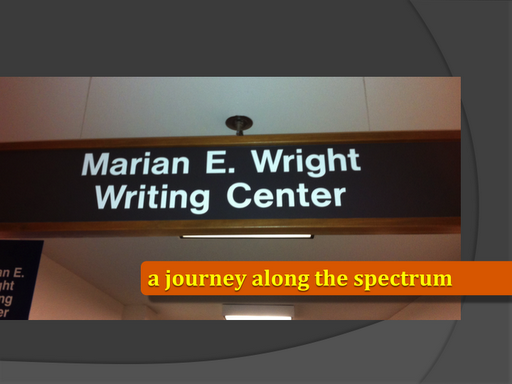
Hi. I’m Roger Austin. I’m a tutor at the Marian E. Wright Writing Center at the University of Michigan-Flint. We’re a small to medium sized writing center, with between 15-20 student tutors on staff in a given semester. I’m talking today about negotiating how we approach our use of directiveness as tutors.


Like my fellow tutors, I underwent a great deal of training – our writing center requires its tutors to take a full-semester class with an observation component – and in that class, we are of course introduced to a whole range of tutoring styles and theories. The intention was to give us the range of options and tools. Our instructor and center director was really specific about only one thing he wanted in the center: “I don’t like minimalism.” So what happened in my first semester tutoring?
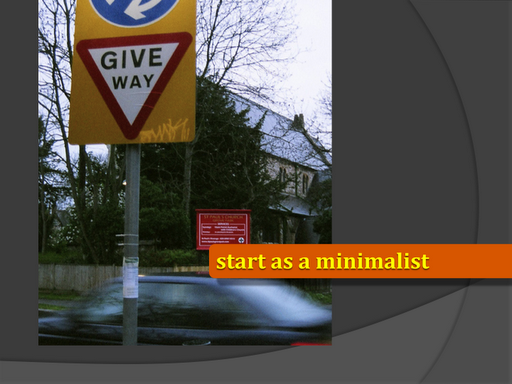
Of course, I went minimalist. I heard myself saying “what do you think” to everything students asked me and I cringed, but I kept doing it. For the first couple of months, I’d sit back and let the students do the work, and the results were usually good, but I felt like I was ignoring opportunities to help them better. Finally, I realized I had started tutoring as a minimalist because I felt intimidated by the power I’d been given over my fellow students. I didn’t want to screw this up. So then what happened for the rest of the semester?
I did the exact opposite. Suddenly I knew the answer, I was in a position to share it, and share it I did. I answered questions with certitude. I suggested the best words. I stopped saying “I think you could” and started saying “I think you should.” I quickly realized this was no better and vowed to move somewhere toward the middle. I had to establish a few things, first.
Writing center tutors are not really peers. Placed in this position of reviewing, critiquing, and suggesting methods of development for other students is scary. We do these things as a peer, but from a formal, institutional role in which the writing center casts us. It’s no wonder there’s a pressure to back off and maintain the sense of peership minimalism offers. The consequences are lower.
On the other hand, it’s easy to swing the other way once the tutor realizes that first and foremost, they are there to help. From there it’s a short trip to seeing writers as possessing “flawed” documents that can be “fixed.” Tutors are put there with an authority. Exercising it is startlingly easy, and what the writer leaves with is undoubtedly a “better” paper, but it is no longer really their paper.
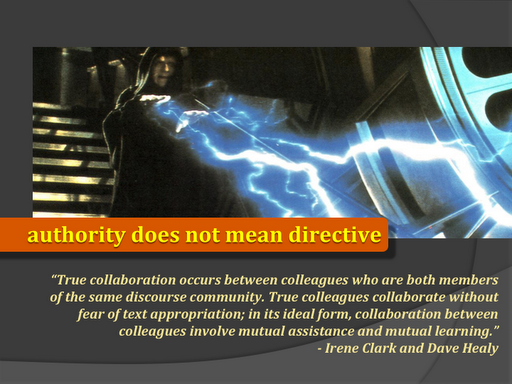
Just because a tutor has authority, that does not mean the tutor should be authoritarian. A tutor has the opportunity to introduce the writer to a two-way conversation about writing: suggestions are made, arguments are examined, and content is weighed, but all decisions to revise remain ultimately with the text’s owner. Two writers discussing a spectrum of writing options while maintaining the authority of both contributors is pure collaboration. How does the tutor define the boundaries of that spectrum, and of that collaboration?
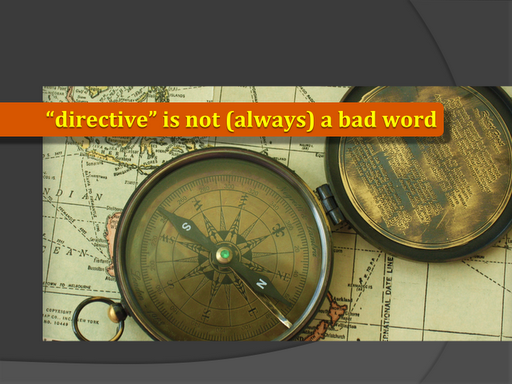
“Directive” is not (always) a bad word. When a writer turns to you not because they want you to do the work, but because they don’t know or aren’t sure how to do the work, give them a direction because they may feel directionless. You don’t have to be a turn-by-turn GPS with “A Paper” as the destination. You can be a compass and give the writer a heading.
But purely directive removes the writer. If a writer hasn’t turned to you for direction, or needs only a little nudge, there’s a fine line for the tutor between making a suggestion and taking over.  Being too directive can preempt the writer’s invention process, mute their voice, and rob them of their stake in the outcome. Instead of showing the writer what they can do to write better, you’ve only shown them how you write better.
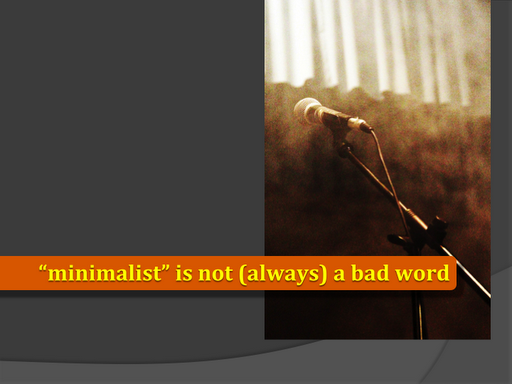
“Minimalist” is not (always) a bad word. When your writer has the idea, has the drive, and has the skills, but needs a sounding board or a warm body to listen to their plans, sit back and see how far they can go. Ask questions about their work, not their questions. Make them think about how their audience will read them, don’t just tell them. Giving the writer a chance to take control can lead them to a better learning experience.
But purely minimalist stalls the writer. Refusing to ever read the writer’s paper to them is denying them the chance to hear their words more objectively. Mirroring the body language of a disinterested writer borders on being petty. If you meet the writer’s every question with a question of your own, you are obstructing their search for answers, while plainly displaying that you know but are not sharing. Doing this abuses your position of authority, is evasive, and almost elitist.
It may be easy to make assumptions about where a writer will be on their spectrum of writing skill, and what help they will need accordingly, but be willing to move along the spectrum to meet your writer where they need you.
When you start out minimal, you offer the writer a chance to step up and assert their authority over their work. If they don’t seem to want that authority, or don’t think they can handle it, help them find it. Even though they didn’t want that authority at first, they may want to take it back from you as the session unfolds. Offer the reins back frequently.
The best sessions can be when you sit back, and with only a few questions or comments, inspire your student to see their own text in a whole new way. Not only can it be enjoyable for you to watch that session unfold so well, but you’re demonstrating that writers own their writing, and can add, subtract, invent, reinvent, or discard their words any time they want.
If the writer resists their authority, insisting they take it helps no one. Ask questions about the assignment. Establish what they know about their topic. Make suggestions. Tell them if something isn’t clear. Tell them there are alternatives, and don’t be afraid to show them a few. If their paper lacks a clear thesis, tell them so. If a supporting argument is underdeveloped, tell them that. This doesn’t mean you have to tell them exactly how to fix it.
The best sessions can also be when you help a writer who was frustrated by their work step back, break the assignment down into its component parts, and help them form a plan to attack each one. Not only can it be enjoyable for you to watch that session unfold so well, but you’ve also defanged the assignment before it became unmanageable, and have show them that a hard assignment is not an impossible assignment.
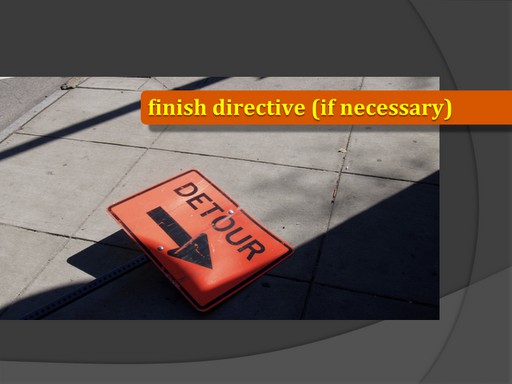
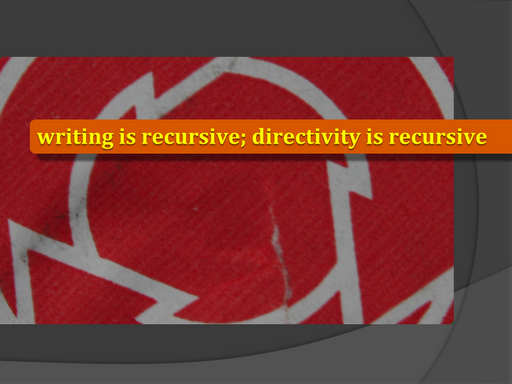
We tell our writers that writing is a recursive process that moves back and forth along invention, drafting, and revision constantly. The journey along the spectrum of directivity is not a straight line, but a path that twists back on itself. Starting minimalist and going directive doesn’t mean the tutor has to stay directive. If the session needs to start directive, it doesn’t mean the tutor can’t put the power back in the writer’s hands by offering more minimalist input later.
The writer may have abandoned control, but it is the tutor’s duty to keep giving it back. The writer may keep pushing the reins away, and if they do, don’t force the issue. The writer may also want to take the reins back after seeing one barrier fall away, and be eager to push the rest aside themselves.
Writers exist at many places on the spectrums of writing skill and engagement. By moving fluidly along the spectrum of directivity, tutors can more nimbly intercept the writers wherever they are on their personal writing spectrums, and more assuredly guide them to where they want to go.
Thank you.

Initial thoughts on the conclusion of #NCPTW

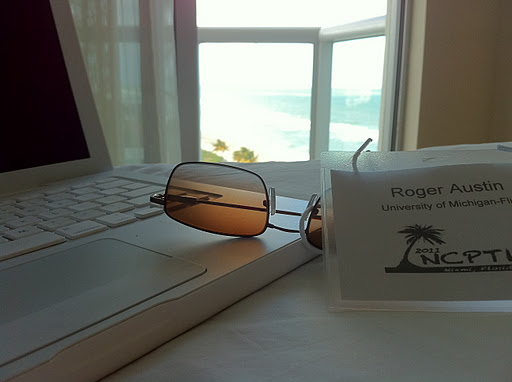
I sit now on the balcony of my hotel room in Miami. The Atlantic churns steadily below, but it has been especially tumultuous since yesterday afternoon. My notions of a post-conference dip were pulled out to sea with the riptide warning that’s been in effect for almost the entire weekend. I, of course, curse myself now for having left some work to do on my presentation Thursday afternoon. The feeble consolation prize wade I took tonight only deepened that regret: the water was pleasantly warm and would have been perfect for a swim, except for those pesky 10 ft waves and the purple flag advisory indicating the presence of “Dangerous Marine Life.”
Fortunately, I did not just wade into the National Conference on Peer Tutoring and Writing (see what I did there? Heh. Writing is neat). Having been to one conference already this year as an attendee, a second as a co-presenter, and finally NCPTW as a solo presenter, I knew well enough to really get in deep and get soaked this time. I’d scheduled my flights for the purpose of taking in the whole conference without missing a session, and I kept to that plan. Being a first-time attendee to NCPTW, I went off the assumption that it’d be a bunch of tutors talking about tutoring. I was right, but it really was so much more.
When you really commit to something, really think about it as constantly as I have come to do with writing center theory in the past 12-18 months, a thought roams wider inside your head the deeper you go: Am I really getting this, or am I just scratching the surface in a pale imitation of real theorists? The answer NCPTW provided: I am just scratching the surface, but I am also really beginning to get this.
Many times this weekend, I found myself simply getting it. I don’t know how else to describe that sense of philosophical zen or oneness. I didn’t necessarily agree with everything I heard, but what I observed in sessions and their related discussions was relatable to something I had experienced, had read about, or as in some cases, had been studying closely myself. Jennifer Forsthoefel (Georgia State), in talking about achieving (or retaining) peerness in a writing center session as a graduate writing tutor/consultant, made observations very similar to my own from my session the day before, even going so far as to draw her theory from some of the same sources.
This unexpected philosophical parity is reassuring, but not because I feel like someone working at a higher level has independently drawn some of the same conclusions I have. It’s that I know I’m not off in left field, not completely missing the point of these key discussions. It’s exciting to realize that while I may not yet have joined the larger venues of the discussion, I recognize that I’m almost there. I’m only scratching the surface of what the sessions at NCPTW accomplished for me right now, and I really hope to explore the after-conference effects in upcoming posts.
So to shoehorn home the metaphor I so artlessly started earlier, attending and presenting at NCPTW has gotten me to a point past wading and past treading water. I’m not swimming in the rough surf yet, but NCPTW has at least convinced me I’m in no imminent danger of rhetorically drowning. Now about that “Dangerous Marine Life” …
Special note: I’d like to express my sincere appreciation to the selection committees working with the University of Michigan-Flint’s Fran Frazier Travel Grant and NCPTW’s Registration & Grub Grant. The support provided by these grants made this trip and all its positive results possible.

A Tweet of Three Conferences – #cwcon, Lilly, & #NCPTW

A few months ago, I attended Computers and Writing 2011 in Ann Arbor. I went at the suggestion of James Schirmer, who correctly thought I’d find the topics there interesting. But this story is not about that conference … much.

A few weeks ago, I was asked by Jacob Blumner to attend the Lilly Conference in Traverse City, and also to fill in for his role in a joint presentation with faculty connected to the Doctor of Nursing Practice/Marian E. Wright Writing Center online writing collaboration. But this story is not about that conference … much.

What this story is about is the role of Twitter in such academic venues. In the case of one conference, the role was robust, and in the other practically non-existent. The only detour into the actual conference content I’ll take is to acknowledge that I was frankly far more interested in the C&W schedule, being that it aligns so closely with my own interests, both personally and academically. The Lilly schedule was much more multi-disciplinary, its strength lying in drawing ideas from multiple systems of thought. I should probably note that, given the groups the conferences would attract, it’s probably not surprising that C&W was the conference big on tweets.

What strikes me is the opportunity missed by Lilly organizers and attendees to enhance their conference discussions. The rich, swift moving Twitter backchannel discussion at C&W stands out as one of the best experiences related to the conference. Not only was I benefitting from the enriching discussions from attendees and presenters of the sessions I was personally attending in the physical world, but I was also gleaning additional insights from the same people in the digital space concurrently. Twitter also offered benefits not possible in the physical space: participants who didn’t feel comfortable speaking up in the session, or who missed the opportunity to contribute in a timely manner but still wanted to offer a comment, and participants who wanted to distill the proceedings into salient takeaways all had a venue in which to speak. And as a bonus, pearls of insight freshly shucked in other concurrent sessions had an outlet to attendees who may have wanted to join in, but chose to participate in other, equally-tempting sessions. At C&W, thousands of #cwcon tweets created an entirely secondary conference experience over the course of four days, not even accounting for the days leading up to and weeks after. Any combination of search terms you can think of related to the Lilly Conference, including the official Twitter account, produces barely a dozen relevant results – two of them were my own, and there were hundreds of attendees there.

This comes just a month shy of my trip to the National Conference on Peer Tutoring and Writing in Miami (shameless plug: join me for “Tutoring Across the Spectrum of Directivity,” tentatively scheduled for Saturday morning, Session B at 8 am – stay tuned for changes!). I anticipate that just like the C&W conference in May, the NCPTW conference is more applicable to a narrower group of subjects, which may bolster the interest all attendees may have in most sessions, both in sharing and learning from second-hand. By contrast, the sessions at Lilly were much more varied in subject and scope, so the universality of interest must have been lower. I think the fate of Lilly can be easily avoided at NCPTW, and I think the conference experience would be better for it.

Unfortunately, at this moment there’s nothing to indicate an official Twitter presence for this upcoming NCPTW conference. Being the busy body I can be sometimes, I’ve just emailed the social networking coordinator for NCPTW, suggesting a more formal effort here. Until I get a response, I’m going to start tweeting with the #NCPTW tag. I do hope something official is announced soon, and well before the actual start date. *** Beside the obvious benefits of a concurrent conference backchannel, Twitter functions well in its most basic role as a social network, allowing attendees to connect before they arrive, plan what they intend to do during non-conference times, and to build networks of like minds to carry with them beyond the sessions.

I truly hope that either #NCPTW or something similar can take off as an umbrella hashtag. Even if I’m surrounded by those of a similar interest in Miami, I’d hate to feel as detached from other attendees as I did at the Lilly Conference.

*** EDIT: I’ve had the pleasure of learning from the NCPTW Social Networking Coordinator that they’ve taken my suggestion and created @NCPTW. Now to swell the following ranks…

For Good Measure – Priorities

At 11:23 Friday, I used a break from my legendary opticianry to be witness to one of the saddest things I’ve seen as an American. It was delayed a few moments in happening to ensure safety, but at 11:29, Space Shuttle Atlantis lifted off, carrying four astronauts and supplies bound for the International Space Station.

This was the last shuttle mission. The last planned manned space launch. It was so definitely the last mission that, unlike all missions before it, no other Shuttle and crew were on standby to rescue STS135 in the event of craft failure in orbit. Thus, the crew was limited to only four, the number of people the ISS and a returning Russian Soyuz capsule could accommodate.

We let the shuttle program expire with nothing ready to pick up where it left off, and worse, the planned replacement isn’t even a sure thing. The earliest date for the US to return to space is set at maybe-gonna-happen-but-likely-to-be-delayed 2016. NASA is targeted constantly for defunding of its already ludicrously low budget.

I do not want to detract from the impressive and valuable work of NASA’s unmanned science missions in landers and probes. With Hubble, Spirit/Opportunity, and New Horizons as prime examples,the usefulness of our inspiring unmanned exploration initiatives is not the issue (although I’m not surprised that recent house appropriations proposals would see the James Webb Space Telescope, the successor to the aging Hubble Space Telescope, pretty much killed). What galls me, even as a humanities academic-to-be, is our complete disregard for the science necessary to support the future of humanity. We cannot stay on this single lump of dirt orbiting one star indefinitely. We cannot hope to eek out a “quality” of life equal to our current level forever if we restrict ourselves to this finite, limited Earth.

I’m not trying to be the Star Trek Geek Roger with this rant; I understand that the future of space exploration isn’t easy. Theoretically, we are going to be confined to this solar system for centuries, and may never be able to leave. Space is expansive and expensive, hazardous and humbling. While I personally believe that the limitations we’re unable to reconcile now have more to do with our inexperience than true, iron-clad, immutable laws, I recognize that it isn’t practical to see a future galavanting with the Vulcans, Klingons, and Cardassians – the science doesn’t support it. The science does support distribution of  population, resource riches great enough to achieve a post-scarcity society, and a better understanding of our/Earth’s evolutionary past. 

I don’t buy the argument that the money is better spent on Earth. When two years of Iraq/Afghanistan operations exceed NASA’s ENTIRE 50+ year budget, the argument of mutual exclusivity looks particularly absurd. Such backward thinking is what brought us here today, to an America without a manned spaceflight program and vague, ever-movable timelines for a return to the moon or a trip to Mars. 

When Atlantis returns to Earth on July 20 – the 42nd anniversary of the first moon landing and a painful juxtaposition to behold – it will be the last display of America’s human space flight for at least five years. Atlantis will then be decommissioned, stripped down, and take up residence as the centerpiece of a public exhibit at the Kennedy Space Center, flipped upside down with its bay doors perpetually open. The concept is to recall Atlantis as it lived, in orbit around Earth, frozen in a pose it may have held when it was 190 miles above our heads instead of 192 feet. Like all taxidermy, however, I’m inclined to think it will exhibit not a farcical recreation of life, but a chilling, spectral memorial of death. How long must we wait for a new friend to help us move on from the loss of a three-decade friendship?