
Parting thoughts on #560wr Book Sprint


Above is a Wordle cloud for the second draft of Chapter 3: “Tearing Down the Wall: Defining ourselves as social instructors in-person and online.” Anyone wishing to view and comment on this work in progress is welcome to read it here (with permission from coauthor Scott Atkinson).

The Sprint is over, but did we find a book at the finish line? Yes. No. Did we find SOTAB (something other than a book)? Yes. No. Does the group’s collected writing have a future beyond this? Definitely maybe.

Last week concluded the ENG 560 Book Sprint course (cleverly referred to in earlier posts as Text Dash). If you look at the foremost goal of such a class being to foster durable scholarship, we’ve met our goals. The class certainly covered a lot of ground in a collective two-week writing binge, and even more in the following one week revisionfest. I, speaking strictly personally as a participant in the class as a student, am happy with the results at the end of the course. It was fun, engaging, and despite early angst over topic, roles, and planning, the collective cranked out a respectable stock of interesting work. I look forward to reading the forthcoming compilation.

As someone looking to take this beyond student territory, however, I confess I’m a little nonplussed over the overall disinterest in the work’s post-class life. When I first heard about the Book Sprint concept far prior to class, I found the possibility of producing such significant, detailed scholarship in so short a time enticing. I’ve always been a binge writer, and formalizing that into a collected effort with other like-minded writers sounded like fun, as corny as that may seem. As I said earlier, I understood a class based on Book Sprints would have to be structured differently due to time, space, and rubric constraints. I was fine with that because I thought the essence of Book Sprint would remain: a blur of collaborative scholarship kindled by common interest, and a hope to join the larger discussion, whatever the mode.

We met one final time last week, with the writing and first round of edits already done, and tasked ourselves with just one question: What now? The answer was a resounding shrug.

The one-two punch of a Book Sprint, in my personal view, was collaborate-contribute. One month ago, I thought part 2 was a given, and the angst over part 1 was our only obstacle. I wonder if a lot of indifference centered around a fear that what we’d written wasn’t good enough to publish. That’s fair; our collection isn’t publishable as-is and that shouldn’t be a surprise. The lack of willingness to continue with the project, however, is truly disappointing. I’m left wondering if some fellow students had ever planned on more than a transaction: enroll>get assignments>complete assignments>get grade. That we were never on the hook for further contribution has always been clear, but I had anticipated there would have been more interest than I saw last week. What’s frustrating is that very few people actively opted out, but neither did many opt in.

We ultimately “decided” (meaning, with no other plans gaining consensus, we settled) on waiting for responses to the forthcoming read-through of the collected work, and then deciding where to go after that. Through email – outside of class – when some are disinterested, some have graduated and moved on, and some are eager for some sort of plan beyond. I worry that it will be impossible to then build any sort of consensus on necessary edits/revisions, what to do with the work of those opting out, and in what format to pursue distribution. This seems to run directly counter to the spirit of collaboration and contribution Book Sprints should ideally foster.

As that final class wore on, I sensed this unfortunate fate taking shape, and feebly tried to express my (grudging) new interest in taking our work off individually. This was received about as warmly as anything else discussed that night. To be clear, this is something I do not want, and I would much rather remain as a part of a group effort, but seeing the individual efforts succumb to a collective apathy is something I desire even less. I tried to play it gently, not wanting to appear snobbish about the quality of the work Scott and I produced (because really, I think all of the chapters have the same potential to be independently published after revisions), but now I’ll come out and say it: Scott and I worked hard on this project, and both feel there’s a lot more left to do, and more we want to do. I don’t want to speak for Scott too broadly, so I personally will say that I feel held hostage to the apathy of others.

I really want to take this work further. I hope that after reading the whole of everyone’s work, others will think similarly. This project has the potential to not only be personally valuable to the contributors, but also the beginning of an interesting legacy for the UMFlint English program, maybe as sort of ongoing project that future graduate cohorts will want to contribute to. I hope the students in this first ever section realize the potential they hold to define how this class exists – or perhaps does not – in the future.
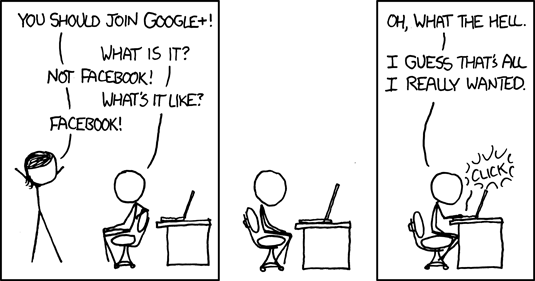
"All I Really Wanted"

(credit: XKCD)
Despite being aware of Google’s plans to make a Not-Facebook alternative, yesterday’s launch of Google Plus snuck up on me. Aside from trying out different ways of referencing the service (Google+, Plus, GPlus, G+, +), I’ve spent a bit of time dinking around this morning.

I find myself happy to explore it, but I can see right off that it really is a Facebook clone. What’s the difference? Where my Facebook account has sat largely dormant for well over a year, I find myself as interested in Plus as I was back when I first joined Facebook in 2007. If the functionality is largely identical, then it must be something harder to define. Naturally, I’ll try to define it.

Facebook, and perhaps now Google Plus, are concepts. Facebook was about connecting with various people in a unified space, sharing what you found interesting, and casually socializing without the premeditated substance of emailing or calling someone. It was a trimmed down, more mature, calmer version of MySpace, someplace I’d deigned to join due to its embrace of the dramatic and spastic. It was simple enough, and perhaps most importantly, it was social. Being social was the concept, removed from clutter and complication.

Now shove the names around. Facebook, despite its better aesthetic, has become MySpace, and GooglePlus offers what Facebook once did – in spirit. It’s no longer about what Facebook is, it’s about what Facebook isn’t. I know some reasons I don’t use Facebook now: it encourages self-agrandizing, self-loathing, and self-pity; it has become almost compulsory to be there, thereby making me push away more; businesses have seized upon it as the thing they must do, vainly hoping that appearing current and connected shows the worth of their product/service.

I think the most significant change in my opinion about Facebook came when I noticed my attitude shift about friend requests. After seeking out the core of friends I actually wanted to see and interact with, the secondary friends began to trickle in. I added them because, after all, the point was to be social, and maybe I’d get to know them better through Facebook. Then the tertiary friends – pretty much the acquaintances – arrived. I made the first concession: I didn’t dislike them, so why begrudge adding them. Then the people who truly complicated things arrived: family with whom you conduct yourself differently; professional contacts who you had to worry would be a risk to oversharing, but who you wanted to have connected for the off chance of a professional benefit. Friend requests became fraught events; do I add this person and possibly add more drama to my wall? Do I do so to be diplomatic, or because I like them? What do I risk by declining?

Then you start seeing the effects of such a mixing of peoples without restraint: a constant tide of drama, with people taking offense at another’s sharing, the shaking of fists across ideological divides, and factioning into groups based on what we are/aren’t and like/dislike. It became a chore to log onto Facebook. All of this had a chilling effect on my willingness to share. I’d waffle back and forth between “I’m a whole person here, and if they don’t like the whole person, they can unfriend me” and “Hmmph. Without context, this could seem odd/stupid/offensive.” I’d always try to move back to the “screw it – take me as I am” side, but thinking of what to share became a process of rationalizing. I’d more often then not end up saying “screw it – it’s not important” instead, and not post/participate. At the same time, I was introduced to and began to increase my use of Twitter, where brief and topical socialization was (and still is, largely) all there was to do. In the end, I’ve come to realize it’s that Facebook made me feel asocial. Not a good thing for a social networking site to inspire.

As I wrote this post, Alan Benson mentioned (on Google Plus) something that lead one of his respondents to what I hope will be the key difference: Circles will be key to avoiding this asocial behavior. Facebook added friend groups, and the ability restrict content sharing by groups, but after a couple of years of letting the melting pot of the “everybody into the (one) pool” approach roil and scorch, the damage had been done for people like me. I’d become disinterested in Facebook and its concomitant drama/angst. So from the outset, I’ll make use of these Circles. As Plus gets moving, I’ll keep this up and make use of sharing settings. I’d like to have Facebook back in the way I once liked it, where socialization was the key component.

Oh, and Google? Keep accounts to individuals only to preserve the social nature. When I see businesses advertise their Facebook profile, I can only think of AOL keywords. You don’t want that.

An opportunity for some of that #560wr collaboration we’ve all been after.

Below you can find some extremely rough drafting of what I’ve written so far for mine and Scott’s chapter, tentatively titled “Breaking down barriers: defining ourselves as social instructors.” I invite anybody from 560 (or anyone else, really) to comment or offer feedback. I don’t know what use this will be without being positioned in the whole piece, but there it is. As I add larger chunks, I’ll include it here.

—-

            To define ourselves as social instructors, we must do what we can to encourage our composition students to become more social themselves. Part of that is going where the students are social, where they are comfortable. After all, they have to step into what they see as your turf when they enter the classroom; why shouldn’t you be willing to step into what is arguably their turf?
            Students are increasingly social online, through popular social media outlets, and the happy accident of this is that they are therefore writing socially. So far, as several high profile venues entered and exited the “it” zone in the past decade, almost all have had a crucial commonality: networked, socially connected writing. Jeff Rice, responding to a College English prompt to what College English should be, warned that early college composition classes still rely heavily on isolated, unidirectional writing modes: one writer engages singularly with one text or set of texts, creating a single new text about their individual experience or opinion. The space somewhere else,” Rice offers in contrast, “… is the open space constructed out of connections where multiple writers engaging within multiple ideas in multiple media at multiple moments function. That space somewhere else is the network” (130). This space is enabled by student use of social media. More than functioning as a mere “You already write more than you think; look at your Facebook activity” ward against the “I don’t like to write” students, this networked student writing is a great model for class writing. By encouraging (or requiring?) students to write regular, varied entries to course blogs, message boards, social media feeds, and whatever other public writing you can conceive of, and by encouraging (or requiring?) discussion with each other about their writing, you can build an understanding that any writing can be more networked, more social.
            Before we can attempt guiding others through this sort of border crossing between closed and open networks, perhaps we should demonstrate our own ability to make the crossing. At the time of this writing (and, as much as this sort of disclaimer may be awkward, the fickleness of the online socialscape supports it), Facebook remains the most populated place such social, open network writing can be done. Further, it also lends the instructor the ability to craft their social image outside of the classroom. A 2009 study gauged student reaction to varying levels of their instructor’s activity on a social network, in this case Facebook, drawing a cautious conclusion that instructors who are open and accessible on Facebook may reap classroom benefits: “The findings suggest that teachers who exhibit high levels of self-disclosure on a Facebook website may appear more credible than teachers low in computer-mediated self-disclosure” (Mazer, Murphy, and Simonds, 179-180). “High-levels of self disclosure” is explained as corresponding with friends and family, posting many pictures, and expressing opinions. More simply: the instructors are free to be themselves. By carrying on with the same social persona online as in class, especially if it is not restricted just to class topics, strong impressions of both the instructor’s social verity and social writing are delivered to students. In fact, doing the opposite online has the corresponding opposite effect:
Although our findings reveal a positive association between teacher self-disclosure and perceptions of teacher credibility, instructors should be consistent with their self-disclosure on Facebook and their teaching style in the classroom. Teachers who exhibit a relaxed personality on Facebook with informal photographs and entertaining messages, but operate their classrooms strictly, may create violated expectations resulting in negative effects on students (180).
(? Sociably doing the more common duties of instructorship.)
            Being a sociable while performing in an instructor’s capacity extends beyond face-to-face office hours and after class discussion. Even when doing the duties of maintaining online contact, there’s justification to do so in a less minimalist, more engaged way. Whether used as an out-of-class continuation of in-class discussions or as a stand-alone discussion space for online learning, course message board systems offer obvious benefit. There is room for a more considered role for instructors moderating online discussion boards; several studies in recent years offer insight into how an instructor’s digital presence can shape class, both in-person and online.
            A study of email interaction with students at risk of poor performance, while lasting only a brief 4 weeks, showed that the way an email is constructed is important. Students were split into groups: those who received motivational, but nonspecific email contact about course details, and those who received personalized, individually-detailed correspondence motivating them to improve their progress. The results show that those who received non-personalized contact fared worse in measures of confidence, motivation, and achievement than those who were emailed with individualized messages (Kim and Keller 45-48). (*** Rework)
            Instructor conduct on message boards, however, seems a trickier path to walk. A 2007 survey by Margaret Mazzolini and Sarah Maddison of a significant number of message board postings and their corresponding student feedback surveys teased out two observations: when instructors post, the student conversation tends to die in that thread and; despite a widespread instructor opinion that their own posts are designed to open up conversation and encourage follow-up, the vast majority of their posts are actually closed-ended, direct answers (210-211). Instead of being discouraged from contributing, instructors might be able to take heart: Mazzolini and Maddison disclaim that “forums with fewer student postings and shorter discussion threads than most are not necessarily deficient. It may be that frequent instructor intervention makes discussions more efficient, with less time spent by students pursuing false trails and conducting inconclusive debates” (211). Instructors can also reasonably draw an opposing conclusion from the study details. If student contribution drops off after an instructor jumps in and the instructor contributions are primarily closed to follow-up, then a truly Socratic form of open-ended questions, as the study authors mention, might in fact encourage a more engaged discussion board.  (*** Drifting? How is this “social?”)

On #560wr, TextDash, collaboration, and beanie babies.

p.p1 {margin: 0.0px 0.0px 0.0px 0.0px; font: 12.0px Helvetica}
p.p2 {margin: 0.0px 0.0px 0.0px 0.0px; font: 12.0px Helvetica; min-height: 14.0px}
span.Apple-tab-span {white-space:pre}

I’ve always wondered how much I border on anti-social, especially where classwork is concerned. Throughout much of my education, the words “partner,” “collaboration,” or “group work” used to be instant anxiety cues. It seemed like I almost always ended up as the one who cared most, and therefore the one who fretted through bottles of antacids until turn-in. So maybe not so much anti-social; perhaps mistrusting? Misanthropic? Fortunately, this changed as I joined a community of students/others who seem to share this kind of active care about what they’re working on/writing together.
We’re at the midpoint of ENG 560, a course originally modeled mostly after a now guarded word that someone here might have to pay for if mentioned publicly. Let’s call it TextDash. When I first learned about TextDash several months ago, prior to the creation of the course, this was the nutshell of how it worked: 
  • Professionals/academics from around the region/country who presumably know each other relatively well decide they’d all like to write a book* together, because they believe that the 7-12 of them all really know their way around a topic – let’s say, beanie babies. 
  • Rather than trying to chip away at such a large project like a book* for months/years, in which some contributers are bound to:

    • lose interest in bringing forward a collected work about beanie babies
    • change their opinion of their particular subinterest of beanie babies
    • be delayed by other scholarly work on their specific beanie baby interests
    • have their in-progress research devalued/augmented by other beanie baby scholarship published in the meantime…
  • The writers decide to convene for one short, focused burst of collaborative beanie baby scholarship, hoping to power through all other distractions and emerge – within very short order – with a cohesive, timely, authoritative, collection of their work. Maybe even a book*.
  • The writers agree to set aside a whole block of time (days, maybe even a week) to converge at one place and communally live, eat, sleep, research, and write beanie babies. 
  • Upon meeting, they divide up the time into chunks: topic selection, research, writing, editing, and polishing. Each takes a specific beanie baby subtopic they know (varieties, values, depreciation, the social stigma of renting a two bedroom apartment for you and your beanie babies, the indignity of Ty’s manufactured rarity, throwing out your collection once you realize they really aren’t collectibles, how to integrate that Ty tattoo … down there… into a more respectable coverup, etc..).
  • A crucial dynamic emerges: togetherness. The subtopics are sluiced from dreck and emerge in the same room. The research happens in the same room. Prewriting probably happens in the same room. Then, when it comes time to write, writing largely happens in the same room. Once everyone’s finished drafting, they workshop and revise several times with other writers in the same room. Finally, the collection is polished and sent on its way to meet whatever incarnation it will take, securing its role of influence over other beanie baby scholars for decades – maybe even as a book*.

It was obvious to me when I first learned of TextDash that this could be an awesome basis for a course, but that some things would have to change, especially when it became a summer course. The biggest and most obvious, is that this could not have the same level of immersion a true TextDash could. Assume, very conservatively, that enthusiasts of any topic, beanie babies or other, restrict themselves to 14 hour work days when surrounded with like-minded peers. Even if they meet and collaborate for only 5 days, they’ll spend 70 face-face hours in each other’s presence. Unlike those people who probably at least professionally knew each other and their work, we’re relative novices who, with some exceptions, didn’t know each other prior to entering this course. At the end of 560, we’ll have met in-person for only 20 hours. By necessity, two of those sessions have been very much NOT collaborative, but instead designed to disseminate mutually useful information in the most condensed way possible. I do believe the collaboration that 560 can look forward to will happen in the next few weeks as we write with our chapter partners and edit/revise the results as a class. The other two classes we’ve already experienced also ran up against a difference from our beanie baby counterparts – we don’t all agree on the topic we’ve selected. The first sessions were characterized by disagreement and frustration because we, being relative newcomers to the field, do not have the in-built history our established peers do. Inherently, we were going to feel like any topic we picked was being plucked out of the air. Throw in the complication that we’re not even all from the same field or headed toward the same field, and of course the quality of content brainstorming was going to be reduced. We’re not yet scholars of instruction, being that most of us have not yet taught a class. 
What this class is is an exercise in the basest components of research with an eye toward contributing to a larger discussion. We are originating, researching, and synthesizing new discussion for outside consumption. *: The word “book” has attracted far too much angst in the past 4 weeks. I don’t care if this is a book, a wiki, a novella, an ebook, or if these topics end up lacking the cohesion to justify a collection and we all take our pieces and look elsewhere for contribution (although I sincerely doubt the last scenario will happen). What we are trying to do here is to fit our research and writing into a larger assemblage which is itself joining a larger discussion. I knew from the beginning that the most attractive elements of a true TextDash would have difficulty integrating: in-person back-and-forth brainstorming, immersion with many like-minded writers, and developing a well-honed topic/subtopic relationship were all bound to diminish where the participants meet 2.5 hours per week over 8 weeks and necessarily had to do their work away from each other amidst the rest of regular life. This was never going to be a true TextDash.
Finally, there has been a great deal of – I’ll say it – negativity regarding how we’ve utilized alternatives to face-face time in this class. Speaking primarily of Twitter, but to a lesser extent Google Docs, there have been entirely unproductive snarks about how the #560wr tag has not been active enough. Still, I have yet to hear how there was going to be a robust twitter backchannel to this course when all of the above issues are considered. I love what Twitter can do for subdiscussion in some venues, like during the Computers and Writing Conference sessions, where interesting counterpoints and questions emerged alongside the presentations we were viewing. However, I was irritated by some of the useless, nonconstructive, sometimes openly negative blather some contributers seemed to flood the #cwcon tag with, seemingly being content to be heard rather than to actually say something. (for further reading on my thoughts of CWcon… just wait. I might get around to writing a horribly late post-con entry soon) Up until this week, all #560wr writers were either doing research (very much a read-only kind of mode), or otherwise not sure they had anything worth saying yet. The only thing I dislike more than no class discussion is uninspired, regurgitative class discussion. If you aren’t adding something, squawking like a parrot isn’t better. This also applies to Twitter.
So am I a misanthrope for taking umbrage with how twitchy things have gotten about this class? I hope not. I understand that, like me, participants want to get something out of this besides the class grade – I did not need to take this class for requirements at all, but instead chose to take it because it seemed damned interesting. What I’d like to believe I am is a realist with standards. In this case, my standards are fairly low: take what you can from ENG 560, even if it isn’t your personal ideal. Don’t ignore what’s good because you’ve yet to see exactly what you’d hoped to at the outset. You may yet be surprised at what you gain when everything wraps up in July, especially if you don’t set preconditions.
Kiss that frog beanie baby and see what happens, people.

Wherein one slipped through a crack.

I had an unfortunate experience today in the writing center. For obvious reasons of protecting student identity, I’ll keep some details out. This specific session is not really important except as the McGuffin device for my larger observation.

A student arrived at the front desk at 4pm and wanted to get an appointment to have a paper tutored. We were, unfortunately, fullly booked until at least 5pm. As we’re supposed to do, I attempted to prod out what the paper was, who it was for, and what the student wanted to work on. He didn’t know the instructor, the name or course designation of his class, and all he said was that he wanted to work on his “bibliography.” I book the appointment for another tutor at 5 because I’m scheduled for a one-on-one session with my recurring student from 4-6.

5 rolls around, and because my usual student didn’t come in today, I decide to just take the other tutor’s appointment because she’s in the middle of a lengthy, productive session that’s going to run long. I’m going to rename the original student – the one who wanted a 4 but had to take a 5 – to Michael.

As I sit down with Michael, I attempt to again get some information on what he’s there for. It turns out that “bibliography” means to check his MLA works cited page. Like many professors do, his instructor has provided an augmented style for source formatting, and of course, the instructor trumps style. I also see that the instructor has linked out of his assignment sheet (a raw URL in a Word doc) to a third party site (not a school or the OWL) to find formatting guidelines for the websites. When I saw it later, it looked to be the same as MLA.

It’s a small paper with only 4 sources, and it looks like he’s gotten one of the citations – the solitary book, in a format provided by the instructor – down okay without too much need for correction. Things derail as we get to the other sources, unfortunately, as he tells me his paper is due at 5:30 (It’s now 5:15), and I see he’s pretty much nowhere near MLA guidelines for his three web-based sources: he’s only listed raw URLs. Michael also chooses now to want to take a look at the body of the paper, and ask how to integrate an in-text citation. Knowing that the amount of time we have left combined with reasons I’ll get to a little later means that we simply aren’t going to get his sources fixed in time, I try and steer him to what we can fix. That’s the in-text stuff. This is common in appointments like this; when, for whatever reason, the student is up against a close deadline with more to fix than time permits, we do triage. I try and get here with polite inquiry, explaining that he’s going to have to do a lot for one task: look up the name of an author, if any exists; the name of the page; the name of the website; date of publication, if determinable; and his date of access — three times in 10ish minutes.

Michael doesn’t take well to this, and complains that three times before he’s been to our writing center, and each time he’s left it frustrated. I saw this coming through body language and tone, so I’m ready. I play nice and concerned, and reassure him that I only want to help him fix what we can because time just doesn’t permit for it all. I give him the public-consumption version of the “we just didn’t have time – maybe if you came in earlier” advice.

Michael: Well I tried to come in at 4 pm and you wouldn’t fuckin let me.

Roger: Oookay…

Michael (shoving paper and laptop back into bag): This place is fuckin ridiculous. Are we done?

Roger: If you are…

Michael slams chair, looks expectantly at me.

Roger: I’m… sorry we couldn’t help you more.

Michael: Me too. Fuckin waste of time.

Michael storms out. I sit there for a good five minutes, feeling guilty. Man, I had a feeling at 4 that my scheduled student wasn’t gonna be here today and she wasn’t. I just knew it. I could’ve gotten this guy in and we could’ve done an hour long appointment for 1 page, and I could’ve fixed…  I stopped my line of thinking because, despite my guilt of letting someone walk out in no better a state than they entered, I knew there were factors outside my control that brought us to this point. The biggest, of course, was that Michael brought in an unfinished paper 1.5 hours before it was due and expected to get an appointment immediately.

Here’s the dicey part, and at great length, my point: Michael’s computer illiterate. I know to some who read this (the three of you), that’s instantly a valuable detail that augments everything you just read. Whatever you may feel about the legitimacy of stereotypes about which groups of people are computer illiterate, there are some groups that are prone. Michael was a classic case. Interacting with his laptop was slow and uncertain. Finding his assignment sheet was slow and uncertain. Finding his document was slow, uncertain, and littered with several false starts. Opening a website was slow and uncertain. His Word document was an unformatted single block of text. Typing was slower than hunt-and-peck.

The entire time I was working with Michael was characterized by silent patience while he interacted with his laptop, punctuated by one or two sentences of conversation, then continued waiting. Had a computer savvy user had the same amount of time and work Michael did, we’d still have had a close call because we started so late. Michael made some unfortunate choices in timing, yes, but he had ten times the uphill battle of most other users.

So what’s the solution to this? There’s no doubt that computers are extremely close knit with the college experience now, and even more so writing. However inelegant, is it time we add another placement test for first time students: the computer literacy test? As it stands now, I believe UM-Flint strongly encourages an optional remedial course to some groups, but it’s not a requirement. Would Michael have been better off had he been mandatorily shunted into that class in his first term? What’s the definition of computer literate? How many students like Michael slip through this crack and are forever handicapped by their lacking skillset?

Understanding the nature of the computer illiterate/uncomfortable/novice, whatever term you prefer, is hard for me. I simply am not, mostly by virtue of my interests, but also by virtue of my generation. Am I a hacker? No. Am I a software developer? Not even close. I do know how to use a computer – any computer, I’d wager – and perhaps most crucially of all, I know how to tell when I don’t know enough and how to remedy that.

What about the Michaels?

The Author Amidst Digital Armageddon

I really like my thesis topic.

I’m told it’s not exactly rare, but not exactly common either. Somewhat more unusual, I gather, is that the thesis project I considered undertaking at the very beginning of my MA is mostly what I’ve come to a close with. I count myself lucky. An early proposal for the topic for my first class at UM-Flint was titled: “From Paper to Processor: The Novel at the Onset of Digital Armageddon.”

The basic concepts have stuck around, but I realize the then-title reflects the very issue I’ve come to anticipate my finished product will heavily explore: we are a fearful lot. We are definitely a hearty bunch, us humans. We adapt, move on, and soon barely notice changes, but not before pulling a collective Chicken Little moment first. At the first sign of change, no matter how well-supported history’s assurances are that we’ll survive, we pretty much lose our collective shit.

Back in early 2009, as the Kindle was nearing release, all we heard was fire and brimstone about the future of the book: the publishers would die, taking the tried-and-true champion of the author with them; the book would be quickly pirated and widely disseminated, robbing publishers (oh, and authors too .. yeah..) of livelihood; good novels would suddenly have to wade neck-deep among unfiltered dreck in the absence of official gatekeepers; e-readers would borrow your car without refilling the gas tank; animals would rise against man now that they could secret away digitized manifestos underneath their beds and food bowls for reading in stolen moments.

Being that I enjoy reading and hope to eventually finish writing a book and see it through to publication, I must have taken too seriously the collective freakout that the paper book was on borrowed time, and thus confused the novel as a concept with its medium of dissemination. So my title reflected the message I was hearing: the Novel at the Onset of Digital Armageddon. 

Now at the beginning of 2011, with several versions of the Kindle, the Nook, the Sony Reader (still the worst name of the lot) all behind us, I’ve come to realize the novel will be just fine. Even the iPad will probably have a second version out by the time I turn this thesis in. Sure, the medium is changing, but the novel isn’t under siege. Digital Armageddon is happening, but its the author who is already standing in the midst of the biggest change. To tip my hand on my final product just a little bit, I am beginning to think the changes are for the better.
While I think the single most-obvious benefit the Digital Armageddon holds for the author -the expansion of readership/exposure – outweighs the faults, there are questions to answer:

  • While the author won’t go away, what must they give up and what will they gain? 
  • How will commercial definitions of “profitable” be refined, and what share of profits will authors come to expect? 
  • How will piracy be tolerated, systemically and individually. What examples can book publishers draw from the music and game industries.
  • What kind of independent market will take off? For example, there are many inexpensive and free titles available to e-readers to help swell their catalogs, but what system can we develop to better match a reader to their interests as the sheer volume of available work explodes?
  • How does the role of author as an artist (think ar-teest) stand to be redefined? Will the physical novel remain as an ivory tower for only the truly accomplished and celebrated authors to isolate themselves in?
I’m constantly tempted, as I continue research, to go off on fascinating but ultimately tangential side-quests: the history of e-reading; the technology of e-reading; the implications for education of e-reading growth; what ultimate economic implications will unfold as the industry shakes out suddenly-unnecessary jobs because revenue moves from physical to digital; the frustrating sensory je ne sais quoi surrounding the physical novel that will take several generations to shake out; and fanciful imaginings of reading in the future. I am constantly reminding myself of my focus, including an admonishment that occupies the top of the first page in my document of research notes and random tidbits:

No Matter How Interesting Other Issues May Be –
DO NOT FORGET That the Primary Subject of this Paper is
THE AUTHOR
What a pleasant frustration to have.

Relaunch: An unfocused manifesto?

Today I relaunch my blog. Started first as a class requirement for Fall 2009 English 513: Issues in Digital Rhetoric at University of Michigan-Flint, this will hopefully scratch the itch I’ve been having to talk about what I’m working on apart from what I hope to make official (turned in/published). The original title of the blog was, for some reason I can’t quite fathom now, “pixelated prose.” Not sure where I was going with that. In the time since completing the course, my thoughts on digital rhetoric (a term I still feel misses out on the unwieldy range of topics I’m interested in, yet for which no better alternative exists) and associated issues have greatly expanded. My applications to five PhD programs in Michigan, Maryland, Oregon, Washington, and British Columbia all emphasize my interest here as much as in composition theory.

I’m keeping original posts made from class, as they are markers from earlier on in my digital rhetoric journey. One theme appeared early on, and I believe is worthy of bearing the title for the relaunch. The new title of the blog, “The Digital Naturalized Citizen,” is based on a personal response I had to Marc Prensky’s “Digital Natives, Digital Immigrants.” To grossly oversimplify Prensky’s thoughts: if we apply the metaphor of citizenship to how we integrate with the larger digital world, two groups emerge:

  • the Digital Natives, or those who have lived from so young an age in a world where continual use of sophisticated technology, multimodal electronic communication, and the constant reinvention of the digital landscape are simple facts of life
  • the Digital Immigrants, relative newcomers to the digital world, for whom each new digital venue or application of technology is more likely to cause anxiety due to unfamiliarity than it is to alleviate workload or facilitate easier communication

Beyond the stereotypes of the young whippersnapper who can program the NASA-designed VCR and the tech-illiterate geezer who is afraid to even learn how to use a mouse, the interaction of these groups is more than just a generational divide. The DI and DN think differently. They have each existed so long in a world where the other’s way of thinking/interacting/communicating was fundamentally different. To the DN, the DI seems hopelessly antiquated, a low-bandwidth individual who functions too stubbornly in too few threads. To the DI, the DN seems frenetic, easily distracted, and too reliant on fallible technological gadgets.

Even when trying to be diplomatic, it’s hard to strip descriptions of these groups and their intersection of any dramatic flair. What I said above probably seems over-simplified. It is. That’s why there’s something between the Digital Native and the Digital Immigrant: the Digital Naturalized Citizen.

I’m a Digital Naturalized Citizen, and I’m willing to guess you probably are, too. I was born in 1979 in a house with one antenna-powered cabinet TV, one rotary-dial phone, and my father’s collection of numerous hobby radios. It was the middle 80’s before we had an Atari 2600. It was 1988 before we had cable TV, an Apple IIe, and a Nintendo. It was 1990 before we’d migrated to a touch-tone telephone. Today, I carry a smartphone in my pocket that is capable of outstripping all of those technologies by innumerable factors, and my wife and I collectively own no fewer than 9 devices that regularly connect to the Internet for work, communications, or entertainment. This isn’t mentioned for the sake of a “look how far we’ve come” kind of geekout (although, it is pretty cool), but for you to compare yourself to. How many of us still remember a life when we didn’t use electronic means but rarely, essentially living an almost fully analog life? It happened gradually, but we’ve become as digitally-aware/comfortable/integrated as any so-called Digital Native. We are technically Digital Immigrants, but we have transformed fully, as so many have, to be indistinguishable from the Digital Natives. I feel absolutely comfortable concluding that this middle-generation – a significant population – are Digital Naturalized Citizens.

This goes farther than being the middle-ground voice of reason whenever the DNs or DIs resist each other’s influence. We are the voice in the middle of the debate about technology’s ever-creeping insertion into our lives. We see digital reformation of our society not as the Infocalypse, but more as a metamorphoses from one stage to the next. It. Just. Is. Technology is inert, socially. It is what we want it to be, great or small, a little or a lot. It is in this way I think of technological integration; to keep in mind that these are not digital horsemen of the apocalypse, but merely digital scapegoats for the same tired issues every generation lets its shit get all emotional over: smartphones are not wholesale destroying our minds, but I pity the couple who eat together at the table next to mine, muttering a half conversation over the screens they use to distract themselves from what looks like a failing relationship. It isn’t “The Twitter” that’s destroying a child’s writing, it’s the natural development of a grammar we all engage in based on whatever environment we communicate in most regularly, the schools who are fiscally unable to provide the alternative, and the parents who are unwilling to take up that slack. It isn’t video games that are sapping our children of physical activity, it’s the cultural shift that has become hostile to the social goods of education and green space and has simultaneously discouraged parents from setting limits.

The Digital Naturalized Citizen doesn’t go to pieces when new digital things step onto the scene: he/she realizes we are humans using technology, not the other way around.

Instructor at University of Northern Colorado. Compositionist, rhetorician, husband, gamer, cat guy.